Ch. 11 - Power Series
Briggs - Calculus: Early Transcendentals 3rd Edition
Briggs3rd EditionCalculus: Early TranscendentalsISBN: 9780136847243Not the one you use?Change textbook
Chapter 11, Problem 11.1.23

Use of Tech Linear and quadratic approximation


a. Find the linear approximating polynomial for the following functions centered at the given point a.


b. Find the quadratic approximating polynomial for the following functions centered at a.


c Use the polynomials obtained in parts (a) and (b) to approximate the given quantity.


Find the Taylor polynomial p₃ centered at a=e for f(x)=ln x.

Verified step by step guidance
1
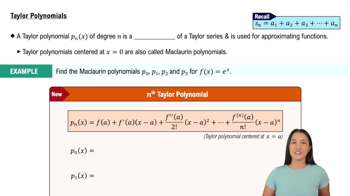
Recall that the Taylor polynomial of degree 3 for a function \( f(x) \) centered at \( a \) is given by: \[ p_3(x) = f(a) + f'(a)(x - a) + \frac{f''(a)}{2!}(x - a)^2 + \frac{f'''(a)}{3!}(x - a)^3 \] This polynomial approximates \( f(x) \) near \( x = a \).
Identify the function and center: here, \( f(x) = \ln x \) and \( a = e \). We need to compute \( f(a) \), \( f'(a) \), \( f''(a) \), and \( f'''(a) \).
Calculate the derivatives of \( f(x) = \ln x \): - First derivative: \( f'(x) = \frac{1}{x} \) - Second derivative: \( f''(x) = -\frac{1}{x^2} \) - Third derivative: \( f'''(x) = \frac{2}{x^3} \)
Evaluate each derivative at \( x = a = e \): - \( f(e) = \ln e \) - \( f'(e) = \frac{1}{e} \) - \( f''(e) = -\frac{1}{e^2} \) - \( f'''(e) = \frac{2}{e^3} \)
Substitute these values into the Taylor polynomial formula: \[ p_3(x) = f(e) + f'(e)(x - e) + \frac{f''(e)}{2}(x - e)^2 + \frac{f'''(e)}{6}(x - e)^3 \] This gives the cubic approximation of \( \ln x \) near \( x = e \).

Verified video answer for a similar problem:

This video solution was recommended by our tutors as helpful for the problem above.
Video duration:
4m
Was this helpful?

Key Concepts

Here are the essential concepts you must grasp in order to answer the question correctly.

Taylor Polynomials

Taylor polynomials approximate a function near a point using derivatives at that point. The nth-degree Taylor polynomial uses derivatives up to order n to create a polynomial that closely matches the function's behavior near the center. For example, the third-degree Taylor polynomial p₃ at a point a approximates f(x) using f(a), f'(a), f''(a), and f'''(a).
Recommended video:
07:00
Taylor Polynomials

Linear and Quadratic Approximations

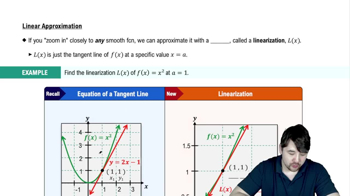
Linear approximation uses the first-degree Taylor polynomial to estimate function values near a point, relying on the function's value and first derivative. Quadratic approximation extends this by including the second derivative, providing a more accurate estimate with a second-degree polynomial. These approximations simplify complex functions for easier calculation.
Recommended video:
07:17
Linearization

Derivatives of Logarithmic Functions

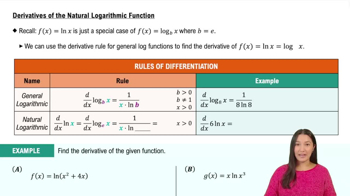
Understanding the derivatives of f(x) = ln(x) is essential for constructing Taylor polynomials. The first derivative is 1/x, the second is -1/x², and the third is 2/x³. Evaluating these at the center a = e allows building the polynomial terms needed for accurate approximations near that point.
Recommended video:
05:18
Derivative of the Natural Logarithmic Function
Related Practice
Textbook Question

Remainders Find the remainder Rₙ for the nth−order Taylor polynomial centered at a for the given functions. Express the result for a general value of n.


f(x) = e⁻ˣ, a = 0

76
views

Textbook Question

{Use of Tech} Remainders Let 


f(x) = ∑ₖ₌₀∞ xᵏ = 1/(1−x) and Sₙ(x) = ∑ₖ₌₀ⁿ⁻¹ xᵏ


The remainder in truncating the power series after n terms is Rₙ = f(x) − Sₙ(x), which depends on x.


a. Show that Rₙ(x) = xⁿ /(1−x).

b. Graph the remainder function on the interval |x| < 1, for n=1, 2, and 3 . Discuss and interpret the graph. Where on the interval is |Rₙ(x)| largest? Smallest?

c. For fixed n, minimize |Rₙ(x)| with respect to x. Does the result agree with the observations in part (b)?

d. Let N(x) be the number of terms required to reduce |Rₙ(x)| to less than 10⁻⁶. Graph the function N(x) on the interval |x|<1.

45
views
Textbook Question

{Use of Tech} Approximating definite integrals Use a Taylor series to approximate the following definite integrals. Retain as many terms as needed to ensure the error is less than 10⁻⁴.

∫₀⁰ᐧ² (ln (1 + t))/t dt

88
views
Textbook Question

Combining power series Use the geometric series


f(x) = 1/(1-x) = ∑ₖ₌₀∞ xᵏ, for |x| < 1,


to find the power series representation for the following functions (centered at 0). Give the interval of convergence of the new series.


f(x³) = 1/(1 − x³)

59
views
Textbook Question

Suppose you use a second-order Taylor polynomial centered at 0 to approximate a function f. What matching conditions are satisfied by the polynomial?

76
views
Textbook Question

Approximating definite integrals Use a Taylor series to approximate the following definite integrals. Retain as many terms as needed to ensure the error is less than 10⁻⁴.∫₀⁰ᐧ²⁵ e⁻ˣ² dx

106
views