
Ch. 10 - Sequences and Infinite Series
Briggs - Calculus: Early Transcendentals 3rd Edition
Briggs3rd EditionCalculus: Early TranscendentalsISBN: 9780136847243Not the one you use?Change textbook
Chapter 10, Problem 10.1.31a

27–34. Working with sequences Several terms of a sequence {aₙ}ₙ₌₁∞ are given.
a. Find the next two terms of the sequence.


{1, 3, 9, 27, 81, ......}

Verified step by step guidance
1
Identify the pattern in the given sequence: {1, 3, 9, 27, 81, ......}. Notice how each term relates to the previous term.
Check if the sequence is geometric by dividing each term by the previous term. For example, calculate \( \frac{3}{1} \), \( \frac{9}{3} \), \( \frac{27}{9} \), and \( \frac{81}{27} \).
If the ratio between consecutive terms is constant, denote this common ratio as \( r \). This means the sequence is geometric and each term can be expressed as \( a_n = a_1 \times r^{n-1} \).
Use the common ratio \( r \) to find the next two terms by multiplying the last known term by \( r \) to get the next term, and then multiply that result by \( r \) again to get the term after that.
Write the expressions for the next two terms as \( a_6 = a_5 \times r \) and \( a_7 = a_6 \times r \), substituting the known values to express these terms explicitly.

Verified video answer for a similar problem:

This video solution was recommended by our tutors as helpful for the problem above.
Video duration:
1m
Was this helpful?

Key Concepts

Here are the essential concepts you must grasp in order to answer the question correctly.

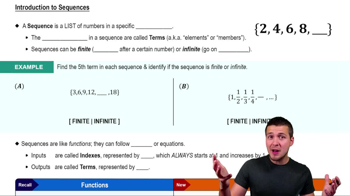
Sequences and Terms

A sequence is an ordered list of numbers following a specific pattern. Each number in the sequence is called a term, typically denoted as aₙ, where n indicates the term's position. Understanding how terms relate helps predict future terms.
Recommended video:
Guided course
8:22
Introduction to Sequences

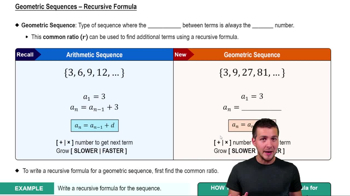
Geometric Sequences

A geometric sequence is one where each term is found by multiplying the previous term by a constant ratio. Identifying this ratio allows you to generate subsequent terms by repeated multiplication.
Recommended video:
Guided course
04:18
Geometric Sequences - Recursive Formula

Pattern Recognition and Prediction

Recognizing the pattern in a sequence is essential to find missing or future terms. This involves analyzing the given terms, determining the rule (such as addition or multiplication), and applying it to extend the sequence.
Recommended video:
03:05
Sigma Notation Example 1