
Textbook Question
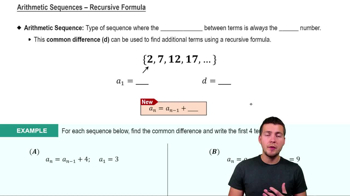
27–34. Working with sequences Several terms of a sequence {aₙ}ₙ₌₁∞ are given.
a. Find the next two terms of the sequence.
{-5, 5, -5, 5, ......}
47
views

 Verified step by step guidance
 6:40
6:40
 07:15
07:15 04:25
04:2527–34. Working with sequences Several terms of a sequence {aₙ}ₙ₌₁∞ are given.
a. Find the next two terms of the sequence.
{-5, 5, -5, 5, ......}
Explain why or why not Determine whether the following statements are true and give an explanation or counterexample.
a. The sum ∑ (k = 1 to ∞) 1 / 3ᵏ is a p-series.
87. Explain why or why not
Determine whether the following statements are true and give an explanation or counterexample.
a. If ∑ (k = 1 to ∞) aₖ converges, then ∑ (k = 10 to ∞) aₖ converges.
27–34. Working with sequences Several terms of a sequence {aₙ}ₙ₌₁∞ are given.
a. Find the next two terms of the sequence.
{1, 2, 4, 8, 16, ......}
27–34. Working with sequences Several terms of a sequence {aₙ}ₙ₌₁∞ are given.
a. Find the next two terms of the sequence.
{1, 3, 9, 27, 81, ......}
Explain why or why not Determine whether the following statements are true and give an explanation or counterexample.
a. n!n! = (2n)! for all positive integers n.