Ch. 2 - Limits
Briggs - Calculus: Early Transcendentals 3rd Edition
Briggs3rd EditionCalculus: Early TranscendentalsISBN: 9780136847243Not the one you use?Change textbook
Chapter 2, Problem 1c

Which of the following functions are continuous for all values in their domain? Justify your answers.


c. T(t)=temperature t minutes after midnight in Chicago on January 1

Verified step by step guidance
1
Identify the type of function: T(t) represents a real-world scenario, specifically the temperature as a function of time.
Consider the nature of temperature changes: Temperature is typically a continuous function over time, as it changes gradually rather than abruptly.
Discuss potential discontinuities: In real-world scenarios, discontinuities might occur due to sudden events, but these are rare and not typical for temperature changes.
Conclude about continuity: Since temperature changes are generally smooth and gradual, T(t) is likely continuous for all values in its domain.
Justify with real-world context: In the absence of sudden, extreme events, temperature as a function of time is expected to be continuous.

Verified video answer for a similar problem:

This video solution was recommended by our tutors as helpful for the problem above.
Video duration:
1m
Was this helpful?

Key Concepts

Here are the essential concepts you must grasp in order to answer the question correctly.

Continuity of Functions

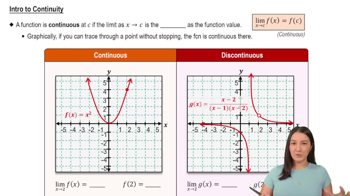
A function is continuous at a point if the limit of the function as it approaches that point equals the function's value at that point. For a function to be continuous over its entire domain, it must be continuous at every point in that domain. This means there are no breaks, jumps, or asymptotes in the function's graph.
Recommended video:
05:34
Intro to Continuity

Domain of a Function

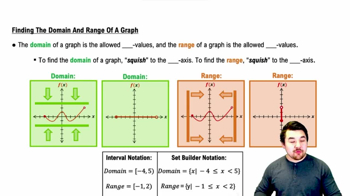
The domain of a function is the set of all possible input values (or 't' values) for which the function is defined. Understanding the domain is crucial for determining continuity, as a function may be continuous on its domain but not defined outside of it. For example, a temperature function may only be defined for certain time intervals.
Recommended video:
5:10
Finding the Domain and Range of a Graph

Real-World Context of Functions

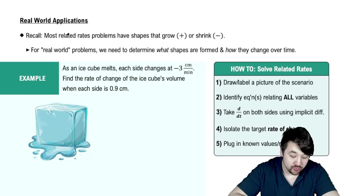
In applied mathematics, functions often represent real-world phenomena, such as temperature over time. Analyzing these functions requires understanding how they behave in practical scenarios. For instance, temperature changes throughout the day can be modeled as a continuous function, but external factors may introduce discontinuities that need to be considered.
Recommended video:
06:16
Real World Application