
Ch. 4 - Applications of the Derivative
Briggs - Calculus: Early Transcendentals 3rd Edition
Briggs3rd EditionCalculus: Early TranscendentalsISBN: 9780136847243Not the one you use?Change textbook
Chapter 4, Problem 4.3.36

Increasing and decreasing functions. Find the intervals on which f is increasing and the intervals on which it is decreasing.


f(x) = x²√(9 - x²) on (-3,3)

Verified step by step guidance
1
First, find the derivative of the function f(x) = x²√(9 - x²). Use the product rule for differentiation, as the function is a product of x² and √(9 - x²).
The product rule states that if you have a function h(x) = u(x)v(x), then h'(x) = u'(x)v(x) + u(x)v'(x). Here, let u(x) = x² and v(x) = √(9 - x²).
Differentiate u(x) = x² to get u'(x) = 2x. For v(x) = √(9 - x²), use the chain rule: v'(x) = (1/2)(9 - x²)^(-1/2) * (-2x) = -x/(√(9 - x²)).
Substitute u'(x), v(x), u(x), and v'(x) into the product rule: f'(x) = 2x√(9 - x²) + x²(-x/√(9 - x²)). Simplify this expression to find f'(x).
Determine where f'(x) is positive or negative to find the intervals of increase or decrease. Set f'(x) > 0 for increasing intervals and f'(x) < 0 for decreasing intervals. Solve these inequalities considering the domain (-3, 3).

Verified video answer for a similar problem:

This video solution was recommended by our tutors as helpful for the problem above.
Video duration:
12m
Was this helpful?

Key Concepts

Here are the essential concepts you must grasp in order to answer the question correctly.

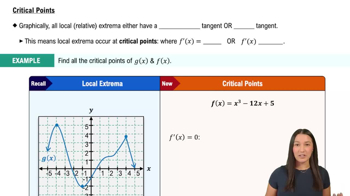
Critical Points

Critical points are values of x in the domain of a function where the derivative is either zero or undefined. These points are essential for determining where a function changes from increasing to decreasing or vice versa. To find critical points, we first compute the derivative of the function and set it equal to zero, solving for x.
Recommended video:
04:50
Critical Points

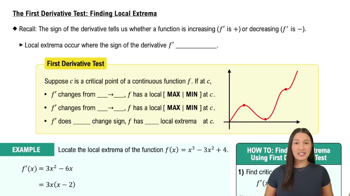
First Derivative Test

The First Derivative Test is a method used to determine the behavior of a function at its critical points. By analyzing the sign of the derivative before and after each critical point, we can conclude whether the function is increasing or decreasing in the intervals defined by these points. If the derivative changes from positive to negative, the function has a local maximum; if it changes from negative to positive, it has a local minimum.
Recommended video:
07:09
The First Derivative Test: Finding Local Extrema

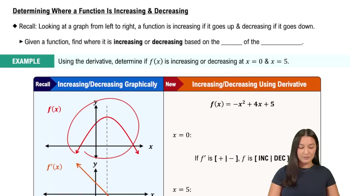
Intervals of Increase and Decrease

Intervals of increase and decrease refer to the ranges of x-values where a function is respectively rising or falling. A function is increasing on an interval if its derivative is positive throughout that interval, and decreasing if the derivative is negative. Identifying these intervals helps in understanding the overall behavior of the function and is crucial for sketching its graph.
Recommended video:
07:32
Determining Where a Function is Increasing & Decreasing
Related Practice
Textbook Question

{Use of Tech} Graphing general solutions Graph several functions that satisfy each of the following differential equations. Then find and graph the particular function that satisfies the given initial condition.


f'(x) = 3x + sinx; f(0) = 3

40
views
Textbook Question

Locating critical points Find the critical points of the following functions. Assume a is a nonzero constant.


ƒ(t) = 1/5 t⁵ - a⁴t

195
views
Textbook Question

23–68. Indefinite integrals Determine the following indefinite integrals. Check your work by differentiation.


∫ (1/x√(36x² - 36))dx

44
views
Textbook Question

{Use of Tech} Special curves The following classical curves have been studied by generations of mathematicians. Use analytical methods (including implicit differentiation) and a graphing utility to graph the curves. Include as much detail as possible.


y = 8/(x² + 4) (Witch of Agnesi)

214
views
Textbook Question

{Use of Tech} Estimating roots The values of various roots can be approximated using Newton’s method. For example, to approximate the value of ³√10, we let x = ³√10 and cube both sides of the equation to obtain x³ = 10, or x³ - 10 = 0. Therefore, ³√10 is a root of p(x) = x³ - 10, which we can approximate by applying Newton’s method. Approximate each value of r by first finding a polynomial with integer coefficients that has a root r. Use an appropriate value of x₀ and stop calculating approximations when two successive approximations agree to five digits to the right of the decimal point after rounding.


r = 7¹/⁴

220
views
Textbook Question

Acceleration to position Given the following acceleration functions of an object moving along a line, find the position function with the given initial velocity and position.


a(t) = -32; v(0) = 20, s(0) = 0

105
views