Ch. 9 - Differential Equations
Briggs - Calculus: Early Transcendentals 3rd Edition
Briggs3rd EditionCalculus: Early TranscendentalsISBN: 9780136847243Not the one you use?Change textbook
Chapter 9, Problem 9.3.51b

{Use of Tech} Tumor growth The Gompertz growth equation is often used to model the growth of tumors. Let M(t) be the mass of a tumor at time t≥0. The relevant initial value problem is 
dM/dt=−rM ln(M/K),M(0)=M0, 
where r and K are positive constants and 0<M0<K.
b. Solve the initial value problem and graph the solution for r=1,K=4, and M0=1. Describe the growth pattern of the tumor. Is the growth unbounded? If not, what is the limiting size of the tumor? 

Verified step by step guidance
1
Recognize that the given differential equation is a Gompertz growth model: \[\frac{dM}{dt} = -r M \ln\left(\frac{M}{K}\right), \quad M(0) = M_0,\] where \(r\), \(K\) are positive constants and \(0 < M_0 < K\).
Rewrite the equation by separating variables. Divide both sides by \(M \ln\left(\frac{M}{K}\right)\) and multiply both sides by \(dt\) to get: \[\frac{dM}{M \ln\left(\frac{M}{K}\right)} = -r \, dt.\]
Make the substitution \(u = \ln\left(\frac{M}{K}\right)\), which implies \(M = K e^u\) and \(dM = K e^u du\). Substitute these into the integral to simplify the left side integral in terms of \(u\).
Integrate both sides: the left side with respect to \(u\) and the right side with respect to \(t\). After integration, solve for \(u\) as a function of \(t\), then back-substitute to find \(M(t)\) in terms of \(t\).
Apply the initial condition \(M(0) = M_0\) to determine the constant of integration. Finally, analyze the solution to describe the tumor growth pattern, noting that the growth is bounded and approaches the limiting size \(K\) as \(t \to \infty\).

Verified video answer for a similar problem:

This video solution was recommended by our tutors as helpful for the problem above.
Video duration:
4m
Was this helpful?

Key Concepts

Here are the essential concepts you must grasp in order to answer the question correctly.

Gompertz Growth Model

The Gompertz growth model describes growth processes that slow down as they approach a limiting size. It is characterized by a differential equation where the growth rate decreases exponentially with the size of the population or mass. This model is often used in biology to represent tumor growth, capturing the initial rapid growth that slows as the tumor nears a maximum carrying capacity.
Recommended video:
09:29
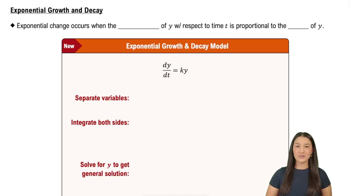
Exponential Growth & Decay

Solving Initial Value Problems (IVPs)

An initial value problem involves a differential equation along with a specified value of the unknown function at a starting point. Solving an IVP means finding a function that satisfies both the differential equation and the initial condition. Techniques include separation of variables, integrating factors, or substitution, depending on the equation's form.
Recommended video:
05:03
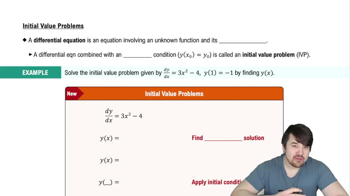
Initial Value Problems

Long-term Behavior and Stability of Solutions

Analyzing the long-term behavior of solutions to differential equations helps determine if growth is bounded or unbounded. Stability analysis identifies equilibrium points and whether solutions approach these points over time. For the Gompertz model, the tumor mass approaches a limiting size (carrying capacity), indicating bounded growth and a stable equilibrium.
Recommended video:
05:21
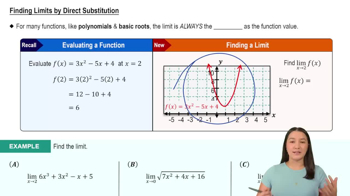
Finding Limits by Direct Substitution
Related Practice
Textbook Question

27–30. Predator-prey models Consider the following pairs of differential equations that model a predator-prey system with populations x and y. In each case, carry out the following steps.


c. Find the equilibrium points for the system.


x′(t) = −3x + 6xy, y′(t) = y − 4xy

52
views
Textbook Question

23–26. Stirred tank reactions For each of the following stirred tank reactions, carry out the following analysis.

b. Solve the initial value problem.


A one-million-liter pond is contaminated by a chemical pollutant with a concentration of 20 g/L. The source of the pollutant is removed, and pure water is allowed to flow into the pond at a rate of 1200 L/hr. Assuming the pond is thoroughly mixed and drained at a rate of 1200 L/hr, how long does it take to reduce the concentration of the solution in the pond to 10% of the initial value?

59
views
Textbook Question

17–20. Increasing and decreasing solutions Consider the following differential equations. A detailed direction field is not needed.


b. In what regions are solutions increasing? Decreasing?


y'(t) = y(y+3)(4-y)

70
views
Textbook Question

38–43. Equilibrium solutions A differential equation of the form y′(t)=f(y) is said to be autonomous (the function f depends only on y). The constant function y=y0 is an equilibrium solution of the equation provided f(y0)=0 (because then y'(t)=0 and the solution remains constant for all t). Note that equilibrium solutions correspond to horizontal lines in the direction field. Note also that for autonomous equations, the direction field is independent of t. Carry out the following analysis on the given equations.

b. Sketch the direction field, for t≥0. 


y′(t) = 6 - 2y

25
views
Textbook Question

Explain why or why not Determine whether the following statements are true and give an explanation or counterexample.

c. The general solution of the equation yy'(x) = xe⁻ʸ can be found using integration by parts.

58
views
Textbook Question

52-56. In this section, several models are presented and the solution of the associated differential equation is given. Later in the chapter, we present methods for solving these differential equations.


{Use of Tech} Free fall One possible model that describes the free fall of an object in a gravitational field subject to air resistance uses the equation v'(t) = g - bv, where v(t) is the velocity of the object for t ≥ 0, g = 9.8 m/s² is the acceleration due to gravity, and b > 0 is a constant that involves the mass of the object and the air resistance.


c. Using the graph in part (b), estimate the terminal velocity lim(t→∞) v(t).

43
views