Ch. 8 - Integration Techniques
Briggs - Calculus: Early Transcendentals 3rd Edition
Briggs3rd EditionCalculus: Early TranscendentalsISBN: 9780136847243Not the one you use?Change textbook
Chapter 8, Problem 8.1.36

7–64. Integration review Evaluate the following integrals.
36. ∫ (t³ - 2) / (t + 1) dt

Verified step by step guidance
1
Step 1: Begin by analyzing the integrand (t³ - 2) / (t + 1). Since the degree of the numerator (t³) is higher than the degree of the denominator (t), perform polynomial long division to simplify the expression.
Step 2: Divide t³ by t + 1. The first term of the quotient is t². Multiply t² by (t + 1), subtract the result from the numerator, and repeat the process until the degree of the remainder is less than the degree of the denominator.
Step 3: After completing the polynomial division, express the integrand as the sum of the quotient and the remainder divided by (t + 1). The integral will now be in the form ∫(quotient + remainder / (t + 1)) dt.
Step 4: Split the integral into separate terms: ∫(quotient) dt + ∫(remainder / (t + 1)) dt. Evaluate each term individually. For the first term, integrate the polynomial quotient term by term using the power rule: ∫tⁿ dt = (tⁿ⁺¹) / (n + 1).
Step 5: For the second term, ∫(remainder / (t + 1)) dt, use substitution if necessary. Let u = t + 1, then du = dt. Rewrite the integral in terms of u and solve. Combine the results from both integrals to express the final solution.

Verified video answer for a similar problem:

This video solution was recommended by our tutors as helpful for the problem above.
Video duration:
4m
Was this helpful?

Key Concepts

Here are the essential concepts you must grasp in order to answer the question correctly.

Integration

Integration is a fundamental concept in calculus that involves finding the integral of a function, which represents the area under the curve of that function on a given interval. It is the reverse process of differentiation and can be used to calculate quantities such as total distance, area, and volume. Understanding the rules and techniques of integration, such as substitution and integration by parts, is essential for solving integral problems.
Recommended video:
06:18
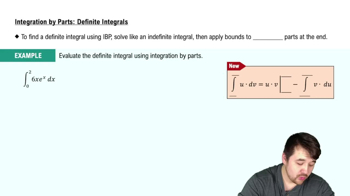
Integration by Parts for Definite Integrals

Polynomial Division

Polynomial division is a method used to divide one polynomial by another, similar to long division with numbers. In the context of integrals, it is often necessary to simplify the integrand (the function being integrated) by dividing polynomials to make the integration process easier. This technique helps to express the integrand in a form that can be integrated term by term.
Recommended video:
07:00
Taylor Polynomials

Definite vs. Indefinite Integrals

Integrals can be classified as definite or indefinite. An indefinite integral represents a family of functions and includes a constant of integration, while a definite integral calculates the net area under the curve between two specific limits. Understanding the difference is crucial for correctly interpreting the results of integration problems and applying the appropriate techniques.
Recommended video:
05:43
Definition of the Definite Integral