Ch. 1 - Functions
Hass - Thomas' Calculus 15th Edition
Hass15th EditionThomas' CalculusISBN: 9780137616077Not the one you use?Change textbook
Chapter 1, Problem 54d

Describe how each graph is obtained from the graph of 𝔂 = Ζ’(x).


d. 𝔂 = Ζ’(2x + 1)

Verified step by step guidance
1
Start with the graph of 𝔂 = Ζ’(x). This is your base graph, which represents the function Ζ’(x) plotted on the coordinate plane.
Consider the expression inside the function: 2x + 1. This indicates a transformation of the graph of Ζ’(x).
The term '2x' suggests a horizontal compression. Since the factor is greater than 1, the graph will be compressed horizontally by a factor of 1/2. This means that each x-coordinate of the original graph will be halved.
Next, the '+1' inside the function indicates a horizontal shift. Specifically, it shifts the graph to the left by 1 unit. This is because the transformation is inside the function, affecting the x-values directly.
Combine these transformations: first, compress the graph horizontally by a factor of 1/2, and then shift it 1 unit to the left. The resulting graph is the graph of 𝔂 = Ζ’(2x + 1).

Verified video answer for a similar problem:

This video solution was recommended by our tutors as helpful for the problem above.
Video duration:
5m
Was this helpful?

Key Concepts

Here are the essential concepts you must grasp in order to answer the question correctly.

Function Transformation

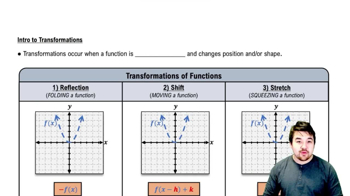
Function transformation refers to the process of altering the graph of a function through various operations, such as shifting, stretching, or compressing. These transformations can be vertical or horizontal, affecting the position and shape of the graph. Understanding how these transformations work is essential for predicting how the graph of a function will change when its equation is modified.
Recommended video:
5:25
Intro to Transformations

Horizontal Shifts

A horizontal shift occurs when the input variable of a function is altered, resulting in the graph moving left or right. In the equation 𝔢 = Ζ’(2x + 1), the term '2x + 1' indicates a horizontal shift. Specifically, the graph shifts to the left by 0.5 units, as the transformation involves solving for x in the form of 'x = (y - 1)/2'.
Recommended video:
5:25
Intro to Transformations

Horizontal Scaling

Horizontal scaling involves stretching or compressing the graph of a function along the x-axis. In the equation 𝔢 = Ζ’(2x + 1), the coefficient '2' in front of x indicates a horizontal compression by a factor of 2. This means that for every unit increase in the output, the input must increase by only half a unit, effectively making the graph narrower.
Recommended video:
04:50
Critical Points