Ch. 3 - Derivatives
Briggs - Calculus: Early Transcendentals 3rd Edition
Briggs3rd EditionCalculus: Early TranscendentalsISBN: 9780136847243Not the one you use?Change textbook
Chapter 3, Problem 3.2.73a

Vertical tangent lines If a function f is continuous at a and lim x→a| f′(x)|=∞, then the curve y=f(x) has a vertical tangent line at a, and the equation of the tangent line is x=a. If a is an endpoint of a domain, then the appropriate one-sided derivative (Exercises 71–72) is used. Use this information to answer the following questions.
73. {Use of Tech} Graph the following functions and determine the location of the vertical tangent lines.
a. f(x) = (x-2)^1/3

Verified step by step guidance
1
Step 1: Understand the problem statement. We need to determine where the function f(x) = (x-2)^{1/3} has vertical tangent lines by analyzing the behavior of its derivative.
Step 2: Find the derivative of the function f(x) = (x-2)^{1/3}. Use the power rule for derivatives, which states that if f(x) = x^n, then f'(x) = n*x^{n-1}.
Step 3: Apply the power rule to f(x) = (x-2)^{1/3}. The derivative f'(x) will be (1/3)*(x-2)^{-2/3}.
Step 4: Analyze the behavior of f'(x) as x approaches the point of interest, which is x = 2. Specifically, evaluate the limit lim_{x→2} |f'(x)| to determine if it approaches infinity.
Step 5: Conclude that if lim_{x→2} |f'(x)| = ∞, then there is a vertical tangent line at x = 2. The equation of this vertical tangent line is x = 2.

Verified video answer for a similar problem:

This video solution was recommended by our tutors as helpful for the problem above.
Video duration:
7m
Was this helpful?

Key Concepts

Here are the essential concepts you must grasp in order to answer the question correctly.

Vertical Tangent Lines

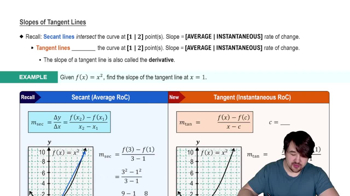
A vertical tangent line occurs at a point on a curve where the slope of the tangent approaches infinity. This typically indicates that the function is changing very rapidly at that point, leading to a vertical orientation of the tangent line. Mathematically, this is represented by the condition that the limit of the derivative approaches infinity as x approaches the point of tangency.
Recommended video:
05:13
Slopes of Tangent Lines

Continuity and Derivatives

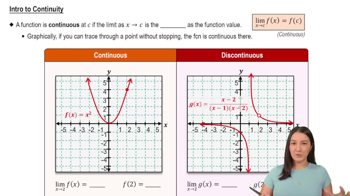
For a function to have a vertical tangent line at a point, it must be continuous at that point. Additionally, the behavior of the derivative is crucial; if the limit of the absolute value of the derivative approaches infinity as x approaches the point, it confirms the presence of a vertical tangent. This relationship between continuity and the behavior of derivatives is fundamental in calculus.
Recommended video:
05:34
Intro to Continuity

One-Sided Derivatives

One-sided derivatives are used to analyze the behavior of a function at endpoints of its domain or at points where the function may not be differentiable in the traditional sense. The left-hand derivative and right-hand derivative provide insights into the slope of the function from either side of a point, which is essential for determining the nature of the tangent line at that point, especially in cases of vertical tangents.
Recommended video:
05:50
One-Sided Limits
Related Practice
Textbook Question

13-26 Implicit differentiation Carry out the following steps.

a. Use implicit differentiation to find dy/dx.

³√x+³√y⁴ = 2;(1,1)

194
views

Textbook Question

7–14. Find the derivative the following ways:

a. Using the Product Rule (Exercises 7–10) or the Quotient Rule (Exercises 11–14). Simplify your result.

g(s) = 4s³ - 8s² +4s / 4s

224
views
Textbook Question

79–82. {Use of Tech} Visualizing tangent and normal lines <IMAGE>

a. Determine an equation of the tangent line and the normal line at the given point (x0, y0) on the following curves. (See instructions for Exercises 73–78.)

x⁴ = 2x²+2y²; (x0, y0)=(2, 2) (kampyle of Eudoxus)

286
views
Textbook Question

Comparing velocities Two stones are thrown vertically upward, each with an initial velocity of 48 ft/s at time t=0. One stone is thrown from the edge of a bridge that is 32 feet above the ground, and the other stone is thrown from ground level. The height above the ground of the stone thrown from the bridge after t seconds is f(t) = − 16t²+48t+32. and the height of the stone thrown from the ground after t seconds is g(t) = −16t²+48t.

a. Show that the stones reach their high points at the same time.

304
views
Textbook Question

Derivatives and tangent lines

a. For the following functions and values of a, find f′(a).

f(x) = √3x; a= 12

184
views
Textbook Question

Deriving trigonometric identities

a. Differentiate both sides of the identity cos 2t = cos² t−sin² t to prove that sin 2 t= 2 sin t cos t.

413
views