Ch. 11 - Power Series
Briggs - Calculus: Early Transcendentals 3rd Edition
Briggs3rd EditionCalculus: Early TranscendentalsISBN: 9780136847243Not the one you use?Change textbook
Chapter 11, Problem 11.4.78c

Sine integral function The function Si(x) = ∫₀ˣ f(t) dt, where f(t) = {(sin t)/t if t ≠ 0, 1 if t = 0, is called the sine integral function.
c. Approximate Si(0.5) and Si(1). Use enough terms of the series so the error in the approximation does not exceed 10⁻³.

Verified step by step guidance
1
Recall the definition of the sine integral function: \(Si(x) = \int_0^x \frac{\sin t}{t} \, dt\) for \(t \neq 0\), and \(Si(0) = 0\) by continuity.
Use the Maclaurin series expansion for \(\frac{\sin t}{t}\), which is \(\sum_{n=0}^\infty (-1)^n \frac{t^{2n}}{(2n+1)!}\). This allows us to write \(Si(x)\) as a power series: \(Si(x) = \sum_{n=0}^\infty (-1)^n \frac{x^{2n+1}}{(2n+1)(2n+1)!}\).
To approximate \(Si(0.5)\) and \(Si(1)\), substitute \(x=0.5\) and \(x=1\) into the series and sum terms until the absolute value of the next term is less than \$10^{-3}$, ensuring the error does not exceed this bound.
Calculate each term of the series using the formula for the \(n\)-th term: \(a_n = (-1)^n \frac{x^{2n+1}}{(2n+1)(2n+1)!}\), and keep a running total of the sum.
Stop adding terms when the magnitude of the next term \(|a_{n+1}|\) is less than \$10^{-3}\(. The current sum will then be an approximation of \)Si(x)$ within the desired error tolerance.

Verified video answer for a similar problem:

This video solution was recommended by our tutors as helpful for the problem above.
Video duration:
6m
Was this helpful?

Key Concepts

Here are the essential concepts you must grasp in order to answer the question correctly.

Definition and Properties of the Sine Integral Function

The sine integral function Si(x) is defined as the integral from 0 to x of (sin t)/t dt, with a special value at t=0 to ensure continuity. Understanding this function involves recognizing it as an integral of a non-elementary function, which cannot be expressed in terms of elementary functions but can be approximated using series expansions.
Recommended video:
05:43
Definition of the Definite Integral

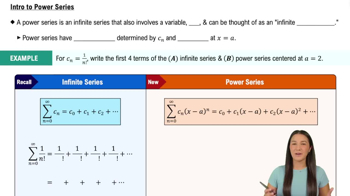
Power Series Expansion of (sin t)/t

The function (sin t)/t can be expanded into a power series around t=0, which converges for all real t. This series is used to approximate the sine integral by integrating term-by-term. Knowing how to derive and use this series is essential for approximating Si(x) with controlled error.
Recommended video:
05:58
Intro to Power Series

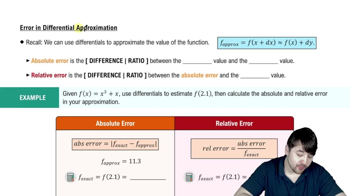
Error Estimation in Series Approximations

When approximating functions using series, it is crucial to estimate the remainder or error to ensure the approximation meets a desired accuracy. For alternating series like the sine integral expansion, the error is bounded by the first omitted term, allowing us to determine how many terms are needed to keep the error below 10⁻³.
Recommended video:
04:57
Determining Error and Relative Error