Ch. 8 - Integration Techniques
Briggs - Calculus: Early Transcendentals 3rd Edition
Briggs3rd EditionCalculus: Early TranscendentalsISBN: 9780136847243Not the one you use?Change textbook
Chapter 8, Problem 8.3.43

9–61. Trigonometric integrals Evaluate the following integrals.
43. ∫ tan³(4x) dx

Verified step by step guidance
1
Step 1: Recognize that the integral involves an odd power of tangent. For odd powers of tangent, it is helpful to split off one tangent term and rewrite the remaining tangent terms using the identity: tan²(x) = sec²(x) - 1.
Step 2: Rewrite the integral as ∫ tan³(4x) dx = ∫ tan(4x) · tan²(4x) dx. Then substitute tan²(4x) using the identity: tan²(4x) = sec²(4x) - 1. This gives ∫ tan(4x) · (sec²(4x) - 1) dx.
Step 3: Split the integral into two parts: ∫ tan(4x) sec²(4x) dx - ∫ tan(4x) dx. Focus on solving each part separately.
Step 4: For the first term, ∫ tan(4x) sec²(4x) dx, use substitution. Let u = tan(4x), so du = 4 sec²(4x) dx. Rewrite the integral in terms of u.
Step 5: For the second term, ∫ tan(4x) dx, recall the standard integral formula for tangent: ∫ tan(x) dx = -ln|cos(x)|. Adjust for the factor of 4x by considering the chain rule.

Verified video answer for a similar problem:

This video solution was recommended by our tutors as helpful for the problem above.
Video duration:
6m
Was this helpful?

Key Concepts

Here are the essential concepts you must grasp in order to answer the question correctly.

Trigonometric Functions

Trigonometric functions, such as sine, cosine, and tangent, are fundamental in calculus, particularly in integration and differentiation. The tangent function, defined as the ratio of sine to cosine, can be expressed in various forms, which is essential for simplifying integrals involving trigonometric identities.
Recommended video:
6:04
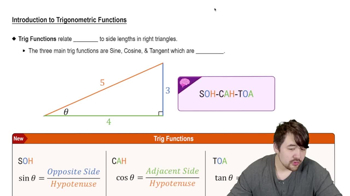
Introduction to Trigonometric Functions

Integration Techniques

Integration techniques, including substitution and integration by parts, are crucial for evaluating complex integrals. In the case of ∫ tan³(4x) dx, recognizing the need to express the integrand in a more manageable form, such as using the identity tan(x) = sin(x)/cos(x), can facilitate the integration process.
Recommended video:
06:18
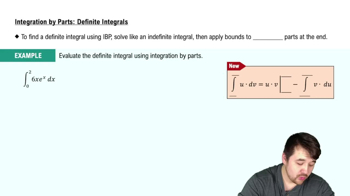
Integration by Parts for Definite Integrals

Definite and Indefinite Integrals

Indefinite integrals represent a family of functions whose derivative gives the integrand. Understanding the difference between definite and indefinite integrals is important, as the former has specific limits and yields a numerical value, while the latter results in a general function plus a constant of integration, which is relevant when solving problems like ∫ tan³(4x) dx.
Recommended video:
05:43
Definition of the Definite Integral