


Ch. 3 - Derivatives
Briggs - Calculus: Early Transcendentals 3rd Edition
Briggs3rd EditionCalculus: Early TranscendentalsISBN: 9780136847243Not the one you use?Change textbook
Chapter 3, Problem 3.1.25a

Use definition (2) (p. 135) to find the slope of the line tangent to the graph of f at P.
f(x) = x2 - 4; P(2, 0)

Verified step by step guidance
1
Step 1: Recall the definition of the derivative as the slope of the tangent line at a point. The derivative of a function f at a point x = a is given by the limit: \( f'(a) = \lim_{h \to 0} \frac{f(a+h) - f(a)}{h} \).
Step 2: Identify the function and the point of interest. Here, the function is \( f(x) = x^2 - 4 \) and the point P is (2, 0). We need to find \( f'(2) \).
Step 3: Substitute \( a = 2 \) into the derivative definition: \( f'(2) = \lim_{h \to 0} \frac{f(2+h) - f(2)}{h} \).
Step 4: Calculate \( f(2+h) \) and \( f(2) \). We have \( f(2+h) = (2+h)^2 - 4 \) and \( f(2) = 2^2 - 4 \).
Step 5: Simplify the expression \( \frac{f(2+h) - f(2)}{h} \) and evaluate the limit as \( h \to 0 \) to find the slope of the tangent line.

Verified video answer for a similar problem:

This video solution was recommended by our tutors as helpful for the problem above.
Video duration:
3m

Key Concepts

Here are the essential concepts you must grasp in order to answer the question correctly.

Tangent Line

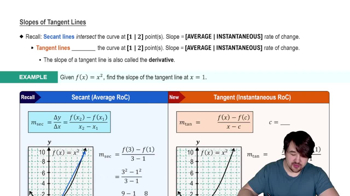
A tangent line to a curve at a given point is a straight line that touches the curve at that point without crossing it. The slope of the tangent line represents the instantaneous rate of change of the function at that point, which is crucial for understanding how the function behaves locally.
Recommended video:
Guided course
05:13
Slopes of Tangent Lines

Derivative

The derivative of a function at a point quantifies how the function's output changes as its input changes. It is defined as the limit of the average rate of change of the function as the interval approaches zero. In this context, finding the derivative of f(x) = x² - 4 will provide the slope of the tangent line at point P.
Recommended video:

Limit Definition of Derivative

The limit definition of the derivative states that the derivative f'(a) at a point a is the limit of the difference quotient as h approaches zero: f'(a) = lim(h→0) [(f(a+h) - f(a))/h]. This definition is fundamental for calculating the slope of the tangent line using the function's values around the point of interest.
Recommended video:
Guided course
05:43
Definition of the Definite Integral
Related Practice
Textbook Question

{Use of Tech} Fuel economy Suppose you own a fuel-efficient hybrid automobile with a monitor on the dashboard that displays the mileage and gas consumption. The number of miles you can drive with g gallons of gas remaining in the tank on a particular stretch of highway is given by m(g) = 50g−25.8g²+12.5g³−1.6g⁴, for 0≤g≤4.

a. Graph and interpret the mileage function.

273
views
Textbook Question

Find an equation of the line tangent to the given curve at a.

y = (x + 5) / (x - 1); a = 3

380
views
Textbook Question

60–62. {Use of Tech} Multiple tangent lines Complete the following steps. <IMAGE>

a. Find equations of all lines tangent to the curve at the given value of x.

x+y³−y=1; x=1

259
views
Textbook Question

{Use of Tech} Flow from a tank A cylindrical tank is full at time t=0 when a valve in the bottom of the tank is opened. By Torricelli’s law, the volume of water in the tank after t hours is V=100(200−t)², measured in cubic meters.

a. Graph the volume function. What is the volume of water in the tank before the valve is opened? 

227
views
Textbook Question

City urbanization City planners model the size of their city using the function A(t) = - 1/50t² + 2t +20, for 0 ≤ t ≤ 50, where A is measured in square miles and t is the number of years after 2010.

a. Compute A'(t). What units are associated with this derivative and what does the derivative measure?

383
views
Textbook Question

45–50. Tangent lines Carry out the following steps. <IMAGE>

a. Verify that the given point lies on the curve.

(x²+y²)²=25/4 xy²; (1, 2)

193
views