Ch. 5 - Integration
Briggs - Calculus: Early Transcendentals 3rd Edition
Briggs3rd EditionCalculus: Early TranscendentalsISBN: 9780136847243Not the one you use?Change textbook
Chapter 5, Problem 5.4.50

Symmetry of composite functions Prove that the integrand is either even or odd. Then give the value of the integral or show how it can be simplified. Assume f and g are even functions and p and q are odd functions.
∫ᵃ₋ₐ ƒ(p(𝓍)) d𝓍

Verified step by step guidance
1
Step 1: Recall the definitions of even and odd functions. An even function satisfies ƒ(𝓍) = ƒ(-𝓍), while an odd function satisfies ƒ(𝓍) = -ƒ(-𝓍). These properties will help us analyze the symmetry of the integrand.
Step 2: Analyze the composition ƒ(p(𝓍)). Since ƒ is an even function, ƒ(p(𝓍)) will depend on the behavior of p(𝓍). Because p is an odd function, p(-𝓍) = -p(𝓍). Substituting this into ƒ, we get ƒ(p(-𝓍)) = ƒ(-p(𝓍)).
Step 3: Use the property of ƒ being even. Since ƒ is even, ƒ(-p(𝓍)) = ƒ(p(𝓍)). Therefore, ƒ(p(𝓍)) satisfies ƒ(p(-𝓍)) = ƒ(p(𝓍)), which means the integrand ƒ(p(𝓍)) is an even function.
Step 4: Apply the symmetry property of definite integrals. For an even function integrated over a symmetric interval [-a, a], the integral simplifies to 2 times the integral from 0 to a. Specifically, ∫ᵃ₋ₐ ƒ(p(𝓍)) d𝓍 = 2∫₀ᵃ ƒ(p(𝓍)) d𝓍.
Step 5: Conclude the simplification. Since the integrand is even, the integral can be simplified as described in Step 4. If further evaluation is needed, substitute specific forms of ƒ and p into the integral and proceed with integration techniques.

Verified video answer for a similar problem:

This video solution was recommended by our tutors as helpful for the problem above.
Video duration:
2m
Was this helpful?

Key Concepts

Here are the essential concepts you must grasp in order to answer the question correctly.

Even and Odd Functions

Even functions satisfy the property f(-x) = f(x) for all x, meaning their graphs are symmetric about the y-axis. Odd functions, on the other hand, satisfy f(-x) = -f(x), indicating symmetry about the origin. Understanding these properties is crucial for analyzing the symmetry of composite functions and their integrals.
Recommended video:
06:21
Properties of Functions

Composite Functions

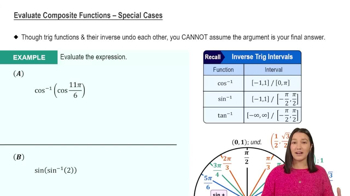
A composite function is formed when one function is applied to the result of another function, denoted as (f ∘ g)(x) = f(g(x)). When dealing with even and odd functions, the symmetry properties of the outer and inner functions can affect the overall symmetry of the composite function, which is essential for determining the nature of the integrand.
Recommended video:
3:48
Evaluate Composite Functions - Special Cases

Integration of Symmetric Functions

When integrating even functions over symmetric intervals, the integral can be simplified to twice the integral from 0 to a, while the integral of odd functions over symmetric intervals equals zero. This property allows for easier computation of integrals involving even and odd functions, particularly in the context of the given problem.
Recommended video:
05:11
Integrals of General Exponential Functions
Related Practice
Textbook Question

{Use of Tech} Areas of regions Find the area of the region 𝑅 bounded by the graph of ƒ and the 𝓍-axis on the given interval. Graph ƒ and show the region 𝑅.                                              


 ƒ(𝓍) = 2 ― |𝓍| on [ ― 2 , 4]

74
views

Textbook Question

Why can the constant of integration be omitted from the antiderivative when evaluating a definite integral?

157
views
Textbook Question

Indefinite integrals Use a change of variables or Table 5.6 to evaluate the following indefinite integrals. Check your work by differentiating.                                                                                  


 ∫ (sin⁵ 𝓍 + 3 sin³ 𝓍― sin 𝓍) cos 𝓍 d𝓍

74
views
Textbook Question

The linear function ƒ(𝓍) = 3 ― 𝓍 is decreasing on the interval [0, 3]. Is its area function for ƒ (with left endpoint 0) increasing or decreasing on the interval [0, 3]? Draw a picture and explain. 

75
views
Textbook Question

Definite integrals from graphs The figure shows the areas of regions bounded by the graph of ƒ and the 𝓍-axis. Evaluate the following integrals.


∫₀ᶜ |ƒ(𝓍)| d𝓍

143
views
Textbook Question

Derivatives of integrals Simplify the following expressions.


d/d𝓍 ∫₀ˣ (√1 + t²) dt (Hint: ∫ˣ₋ₓ (√1 + t²) dt = ∫⁰₋ₓ (√1 + t²) dt + ∫ˣ₋ₓ (√1 + t²) dt ) .

60
views