

Ch. 5 - Integration
Briggs - Calculus: Early Transcendentals 3rd Edition
Briggs3rd EditionCalculus: Early TranscendentalsISBN: 9780136847243Not the one you use?Change textbook
Chapter 5, Problem 5.2.33c

{Use of Tech} Approximating definite integrals Complete the following steps for the given integral and the given value of n. 
(c) Calculate the left and right Riemann sums for the given value of n.
βˆ«β‚β· 1/𝓍 d𝓍 ; n = 6

Verified step by step guidance
1
Step 1: Understand the problem. You are tasked with approximating the definite integral βˆ«β‚β· (1/𝓍) d𝓍 using left and right Riemann sums with n = 6 subintervals. Riemann sums approximate the area under a curve by summing the areas of rectangles.
Step 2: Divide the interval [1, 7] into n = 6 subintervals. The width of each subinterval, Δ𝓍, is calculated as Δ𝓍 = (7 - 1) / 6 = 6 / 6 = 1.
Step 3: For the left Riemann sum, use the left endpoints of each subinterval to evaluate the function f(𝓍) = 1/𝓍. The left endpoints are 𝓍₀ = 1, 𝓍₁ = 2, 𝓍₂ = 3, 𝓍₃ = 4, 𝓍₄ = 5, and 𝓍₅ = 6. Compute the sum: Left Riemann Sum = Δ𝓍 * [f(𝓍₀) + f(𝓍₁) + f(𝓍₂) + f(𝓍₃) + f(𝓍₄) + f(𝓍₅)].
Step 4: For the right Riemann sum, use the right endpoints of each subinterval to evaluate the function f(𝓍) = 1/𝓍. The right endpoints are 𝓍₁ = 2, 𝓍₂ = 3, 𝓍₃ = 4, 𝓍₄ = 5, 𝓍₅ = 6, and 𝓍₆ = 7. Compute the sum: Right Riemann Sum = Δ𝓍 * [f(𝓍₁) + f(𝓍₂) + f(𝓍₃) + f(𝓍₄) + f(𝓍₅) + f(𝓍₆)].
Step 5: After setting up the sums, substitute the values of f(𝓍) = 1/𝓍 for each endpoint into the formulas for the left and right Riemann sums. Simplify the expressions to approximate the integral.

Verified video answer for a similar problem:

This video solution was recommended by our tutors as helpful for the problem above.
Video duration:
4m
Was this helpful?

Key Concepts

Here are the essential concepts you must grasp in order to answer the question correctly.

Riemann Sums

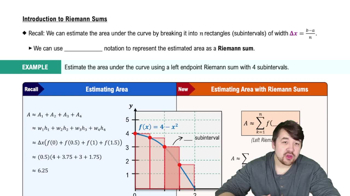
Riemann sums are a method for approximating the value of a definite integral by dividing the area under a curve into smaller rectangles. The sum of the areas of these rectangles provides an estimate of the integral's value. Depending on whether the left or right endpoints of the subintervals are used, the sums can yield different approximations, which converge to the actual integral as the number of rectangles increases.
Recommended video:
06:11
Introduction to Riemann Sums

Definite Integral

A definite integral represents the signed area under a curve between two specified limits, often denoted as βˆ«β‚α΅‡ f(x) dx. It quantifies the accumulation of quantities, such as area, over an interval [a, b]. The Fundamental Theorem of Calculus connects differentiation and integration, stating that the definite integral can be evaluated using the antiderivative of the function.
Recommended video:
05:43
Definition of the Definite Integral

Subintervals and n

In the context of Riemann sums, 'n' refers to the number of subintervals into which the interval of integration is divided. Each subinterval has a width of Ξ”x, calculated as (b - a)/n. The choice of n affects the accuracy of the approximation; a larger n results in narrower rectangles and a more precise estimate of the integral, while a smaller n may lead to greater error.
Recommended video:
06:11
Introduction to Riemann Sums
Related Practice
Textbook Question

Explain why or why not Determine whether the following statements are true and give an explanation or counterexample.

(c) The average value of a linear function on an interval [a, b] is the function value at the midpoint of [a, b] .

55
views
Textbook Question

Properties of integrals Suppose βˆ«β‚€Β³Ζ’(𝓍) d𝓍 = 2 , βˆ«β‚ƒβΆΖ’(𝓍) d𝓍 = ―5 , and βˆ«β‚ƒβΆg(𝓍) d𝓍 = 1. Evaluate the following integrals.

(c) βˆ«β‚ƒβΆ (3Ζ’(𝓍) ― g(𝓍)) d𝓍

42
views
Textbook Question

Properties of integrals Suppose βˆ«β‚€Β³Ζ’(𝓍) d𝓍 = 2 , βˆ«β‚ƒβΆΖ’(𝓍) d𝓍 = ―5 , and βˆ«β‚ƒβΆg(𝓍) d𝓍 = 1. Evaluate the following integrals.

(d) βˆ«β‚†Β³ (Ζ’(𝓍) + 2g(𝓍)) d𝓍

79
views
Textbook Question

Explain why or why not Determine whether the following statements are true and give an explanation or counterexample.                                                                          

                                                                                                                                                                                     (c) The functions p(𝓍) = sin 3𝓍 and q(𝓍) = 4 sin 3𝓍 are antiderivatives of the same function. 

38
views
Textbook Question

Use Table 5.6 to evaluate the following definite integrals.                                                                                                                    

 (c) βˆ«β‚ƒβˆšβ‚‚^⁢ d𝓍/(𝓍² ―9)

86
views
Textbook Question

Mass from density A thin 10-cm rod is made of an alloy whose density varies along its length according to the function shown in the figure. Assume density is measured in units of g/cm. In Chapter 6, we show that the mass of the rod is the area under the density curve.

(c) Find the mass of the entire rod (0 ≀ x ≀ 10) .

53
views