Ch. 1 - Functions
Briggs - Calculus: Early Transcendentals 3rd Edition
Briggs3rd EditionCalculus: Early TranscendentalsISBN: 9780136847243Not the one you use?Change textbook
Chapter 1, Problem 1.R.21

Evaluate and simplify the difference quotients (f(x + h) - f(x)) / h and (f(x) - f(a)) / (x - a) for each function.
f(x) = x2 - 2x

Verified step by step guidance
1
Step 1: Identify the function f(x) = x^2 - 2x.
Step 2: For the first difference quotient, substitute x + h into the function: f(x + h) = (x + h)^2 - 2(x + h).
Step 3: Expand f(x + h): (x + h)^2 = x^2 + 2xh + h^2 and -2(x + h) = -2x - 2h, so f(x + h) = x^2 + 2xh + h^2 - 2x - 2h.
Step 4: Calculate the difference f(x + h) - f(x): (x^2 + 2xh + h^2 - 2x - 2h) - (x^2 - 2x) = 2xh + h^2 - 2h.
Step 5: Simplify the first difference quotient: (f(x + h) - f(x)) / h = (2xh + h^2 - 2h) / h = 2x + h - 2.
Step 6: For the second difference quotient, substitute a into the function: f(a) = a^2 - 2a.
Step 7: Calculate the difference f(x) - f(a): (x^2 - 2x) - (a^2 - 2a) = x^2 - 2x - a^2 + 2a.
Step 8: Simplify the second difference quotient: (f(x) - f(a)) / (x - a) = (x^2 - 2x - a^2 + 2a) / (x - a).
Step 9: Factor the numerator of the second difference quotient if possible to simplify further.

Verified video answer for a similar problem:

This video solution was recommended by our tutors as helpful for the problem above.
Video duration:
5m
Was this helpful?

Key Concepts

Here are the essential concepts you must grasp in order to answer the question correctly.

Difference Quotient

The difference quotient is a formula used to calculate the average rate of change of a function over an interval. It is expressed as (f(x + h) - f(x)) / h, where h represents a small change in x. This concept is fundamental in calculus as it leads to the definition of the derivative, which measures the instantaneous rate of change.
Recommended video:
06:43
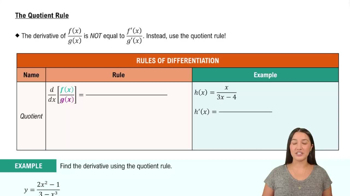
The Quotient Rule

Derivative

The derivative of a function at a point quantifies how the function's output changes as its input changes. It is defined as the limit of the difference quotient as h approaches zero. Derivatives are essential for understanding the behavior of functions, including their slopes, rates of change, and optimization problems.
Recommended video:
05:44
Derivatives

Function Evaluation

Function evaluation involves substituting a specific value into a function to determine its output. For example, evaluating f(x) = x^2 - 2x at x = 3 involves calculating f(3) = 3^2 - 2(3). This concept is crucial for simplifying expressions in calculus, particularly when working with difference quotients and derivatives.
Recommended video:
4:26
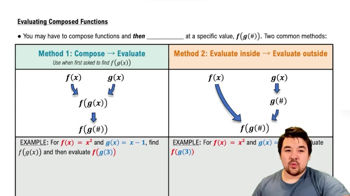
Evaluating Composed Functions