Ch. 5 - Integration
Briggs - Calculus: Early Transcendentals 3rd Edition
Briggs3rd EditionCalculus: Early TranscendentalsISBN: 9780136847243Not the one you use?Change textbook
Chapter 5, Problem 5.R.9d

Integration by Riemann sums Consider the integral βˆ«β‚β΄ (3𝓍― 2) d𝓍.


(a) Evaluate the right Riemann sum for the integral with n = 3 .

Verified step by step guidance
1
Step 1: Understand the problem. The integral βˆ«β‚β΄ (3𝓍 - 2) d𝓍 represents the area under the curve of the function f(𝓍) = 3𝓍 - 2 from 𝓍 = 1 to 𝓍 = 4. To approximate this integral using the right Riemann sum, we divide the interval [1, 4] into n = 3 subintervals.
Step 2: Determine the width of each subinterval. The width Δ𝓍 is calculated as Δ𝓍 = (b - a) / n, where a = 1, b = 4, and n = 3. Substitute these values into the formula to find Δ𝓍.
Step 3: Identify the right endpoints of each subinterval. The right endpoints are calculated as 𝓍₁ = a + Δ𝓍, 𝓍₂ = a + 2Δ𝓍, and 𝓍₃ = a + 3Δ𝓍. Use the value of Δ𝓍 from Step 2 to compute these endpoints.
Step 4: Evaluate the function f(𝓍) = 3𝓍 - 2 at each right endpoint. Substitute the values of 𝓍₁, 𝓍₂, and 𝓍₃ into the function to find f(𝓍₁), f(𝓍₂), and f(𝓍₃).
Step 5: Compute the right Riemann sum. Multiply each function value f(𝓍ᡒ) by the width Δ𝓍 and sum them up: Right Riemann Sum = Δ𝓍 Γ— [f(𝓍₁) + f(𝓍₂) + f(𝓍₃)]. This gives the approximation for the integral.

Verified video answer for a similar problem:

This video solution was recommended by our tutors as helpful for the problem above.
Video duration:
4m
Was this helpful?

Key Concepts

Here are the essential concepts you must grasp in order to answer the question correctly.

Riemann Sums

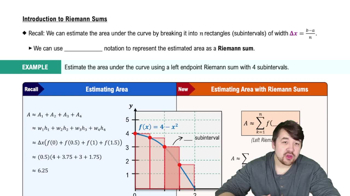
Riemann sums are a method for approximating the value of a definite integral by dividing the area under a curve into small rectangles. The sum of the areas of these rectangles provides an estimate of the integral's value. Depending on the chosen points (left, right, or midpoint) for the height of the rectangles, different types of Riemann sums can be calculated, which converge to the actual integral as the number of rectangles increases.
Recommended video:
06:11
Introduction to Riemann Sums

Definite Integral

A definite integral represents the signed area under a curve defined by a function over a specific interval [a, b]. It is denoted as βˆ«β‚α΅‡ f(x) dx and can be interpreted as the limit of Riemann sums as the number of subdivisions approaches infinity. The Fundamental Theorem of Calculus connects differentiation and integration, allowing us to evaluate definite integrals using antiderivatives.
Recommended video:
05:43
Definition of the Definite Integral

Partitioning the Interval

Partitioning the interval involves dividing the range of integration into smaller subintervals, which is essential for calculating Riemann sums. For n subintervals, the width of each subinterval is Ξ”x = (b - a)/n. In this case, with n = 3 for the integral from 1 to 4, the interval is divided into three equal parts, allowing for the evaluation of the function at specific points to approximate the area under the curve.
Recommended video:
08:44
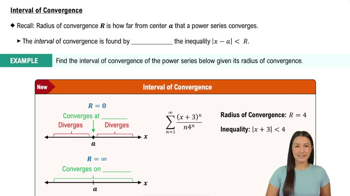
Interval of Convergence
Related Practice
Textbook Question

Change of variables Use the change of variables uΒ³ = 𝓍² ― 1 to evaluate the integral βˆ«β‚Β³ π“βˆ›(𝓍²―1) d𝓍 .

165
views
Textbook Question

Evaluating integrals Evaluate the following integrals.                                                                                                                                      


 βˆ« 𝓍² cos 𝓍³ d𝓍

68
views
Textbook Question

Evaluating integrals Evaluate the following integrals.                                                                                                                                         


 βˆ« 𝓍 sin 𝓍² cos⁸ 𝓍² d𝓍

91
views
Textbook Question

Integration by Riemann sums Consider the integral βˆ«β‚β΄ (3𝓍― 2) d𝓍.


(c) Evaluate the definite integral by taking the limit as n β†’βˆž of the Riemann sum in part (b).

77
views
Textbook Question

Estimate βˆ«β‚β΄ √(4𝓍 + 1) d𝓍 by evaluating the left, right, and midpoint Riemann sums using a regular partition with n = 6 subintervals.

65
views
Textbook Question

Velocity to displacement An object travels on the 𝓍-axis with a velocity given by v(t) = 2t + 5, for 0 ≀ t ≀ 4.


(c) True or false: The object would travel as far as in part (a) if it traveled at its average velocity (a constant), for 0 ≀ t ≀ 4. .

80
views