

Ch. 5 - Integration
Briggs - Calculus: Early Transcendentals 3rd Edition
Briggs3rd EditionCalculus: Early TranscendentalsISBN: 9780136847243Not the one you use?Change textbook
Chapter 5, Problem 5.1.73b

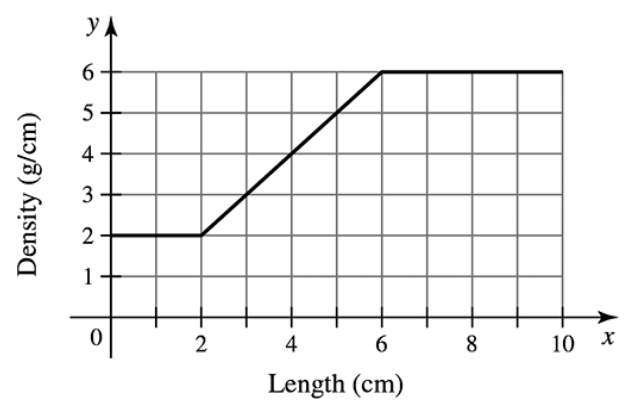
Mass from density A thin 10-cm rod is made of an alloy whose density varies along its length according to the function shown in the figure. Assume density is measured in units of g/cm. In Chapter 6, we show that the mass of the rod is the area under the density curve.
(b) Find the mass of the right half of the rod (5 ≤ x ≤ 10) .
Graph showing density in g/cm along a 10-cm rod, with varying density values plotted against length in cm.

Verified step by step guidance
1
Step 1: Understand the problem. The mass of the rod is the area under the density curve. We are tasked with finding the mass of the right half of the rod, which corresponds to the interval 5 ≤ x ≤ 10.
Step 2: Analyze the graph. The density function is piecewise linear. From x = 5 to x = 6, the density increases linearly from 5 g/cm to 6 g/cm. From x = 6 to x = 10, the density remains constant at 6 g/cm.
Step 3: Break the interval into two subintervals: (a) x = 5 to x = 6, where the density is a linear function, and (b) x = 6 to x = 10, where the density is constant. Calculate the area under the curve for each subinterval separately.
Step 4: For the interval x = 5 to x = 6, the area is the area of a trapezoid. Use the formula for the area of a trapezoid: A = (1/2) * (base1 + base2) * height. Here, base1 = 5, base2 = 6, and height = 1 (difference in x-values).
Step 5: For the interval x = 6 to x = 10, the area is the area of a rectangle. Use the formula for the area of a rectangle: A = width * height. Here, width = 4 (difference in x-values) and height = 6 (density value). Add the areas from both subintervals to find the total mass of the right half of the rod.

Verified video answer for a similar problem:

This video solution was recommended by our tutors as helpful for the problem above.
Video duration:
3m
Was this helpful?

Key Concepts

Here are the essential concepts you must grasp in order to answer the question correctly.

Density Function

A density function describes how mass is distributed along a given length. In this case, the density of the rod varies with its length, represented graphically. Understanding the density function is crucial for calculating the mass, as it provides the necessary values to integrate over the specified interval.
Recommended video:
06:21
Properties of Functions

Integration

Integration is a fundamental concept in calculus used to find the area under a curve. In this context, the mass of the rod can be determined by integrating the density function over the specified interval (5 ≤ x ≤ 10). This process allows us to sum up the infinitesimal contributions of mass along the length of the rod.
Recommended video:
06:18
Integration by Parts for Definite Integrals

Definite Integral

A definite integral calculates the accumulation of quantities over a specific interval. For this problem, it involves evaluating the integral of the density function from x = 5 to x = 10. The result gives the total mass of the right half of the rod, reflecting the varying density across that segment.
Recommended video:
05:43
Definition of the Definite Integral
Related Practice
Textbook Question

Area functions for the same linear function Let ƒ(t) = t and consider the two area functions A(𝓍) = ∫₀ˣ ƒ(t) dt and F(𝓍) = ∫₂ˣ ƒ(t) dt .

(b) Evaluate F(4) and F(6). Then use geometry to find an expression for F (𝓍) , for 𝓍 ≥ 2. 

42
views
Textbook Question

Sigma notation Evaluate the following expressions.                                                                                                                                          

(b)    10                                                                                                                                                                               

       ∑  (2κ + 1)                                                                                                                                                                          

       κ=1                         

83
views
Textbook Question

Displacement from a velocity graph Consider the velocity function for an object moving along a line (see figure).

(b) Use geometry to find the displacement of the object between t = 0 and t = 2.

122
views
Textbook Question

{Use of Tech} Midpoint Riemann sums with a calculator Consider the following definite integrals.

(b) Evaluate each sum using a calculator with n = 20, 50, and 100. Use these values to estimate the value of the integral.


∫₁⁴ 2√𝓍 d𝓍

88
views
Textbook Question

Sigma notation Express the following sums using sigma notation. (Answers are not unique.)

(b) 4 + 5 + 6 + 7 + 8 + 9

99
views
Textbook Question

{Use of Tech} Approximating net area The following functions are positive and negative on the given interval.

f(𝓍) = x³ on [-1,2]

(b) Approximate the net area bounded by the graph of f and the x-axis on the interval using a left, right, and midpoint Riemann sum with n = 4.

49
views