
Ch. 8 - Integration Techniques
Briggs - Calculus: Early Transcendentals 3rd Edition
Briggs3rd EditionCalculus: Early TranscendentalsISBN: 9780136847243Not the one you use?Change textbook
Chapter 8, Problem 8.6.41

7–84. Evaluate the following integrals.
41. ∫ cot^(3/2)x · csc⁴x dx

Verified step by step guidance
1
Step 1: Recognize that the integral involves trigonometric functions cot(x) and csc(x). Rewrite cot^(3/2)(x) as (cot(x))^(3/2) for clarity.
Step 2: Use trigonometric identities to simplify the expression. Recall that cot(x) = cos(x)/sin(x) and csc(x) = 1/sin(x). Substitute these identities into the integral.
Step 3: Combine the powers of sin(x) in the denominator after substitution. The integral will now involve a single trigonometric function raised to a power.
Step 4: Consider a substitution method to simplify the integral further. Let u = sin(x), which implies du = cos(x) dx. Rewrite the integral in terms of u.
Step 5: After substitution, simplify the integral in terms of u and proceed to integrate using standard power rule techniques. Once integrated, substitute back u = sin(x) to express the result in terms of x.

Verified video answer for a similar problem:

This video solution was recommended by our tutors as helpful for the problem above.
Video duration:
3m
Was this helpful?

Key Concepts

Here are the essential concepts you must grasp in order to answer the question correctly.

Integration Techniques

Integration techniques are methods used to find the integral of a function. Common techniques include substitution, integration by parts, and trigonometric identities. Understanding these methods is crucial for evaluating complex integrals, such as those involving trigonometric functions like cotangent and cosecant.
Recommended video:
06:18
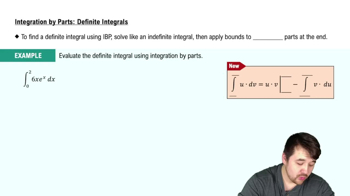
Integration by Parts for Definite Integrals

Trigonometric Identities

Trigonometric identities are equations that relate the angles and sides of triangles through sine, cosine, tangent, and their reciprocals. For example, the identity csc(x) = 1/sin(x) and cot(x) = cos(x)/sin(x) can simplify integrals involving these functions. Mastery of these identities is essential for transforming and simplifying integrals.
Recommended video:
7:17
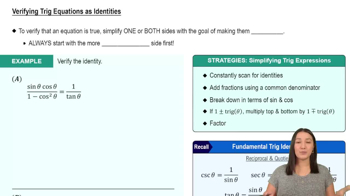
Verifying Trig Equations as Identities

Improper Integrals

Improper integrals are integrals that have infinite limits or integrands that approach infinity within the interval of integration. Evaluating these integrals often requires limits and careful analysis of convergence. Understanding how to handle improper integrals is important for ensuring that the integral can be computed correctly.
Recommended video:
11:11
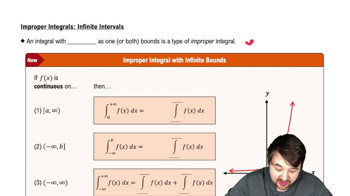
Improper Integrals: Infinite Intervals