Ch. 3 - Derivatives
Briggs - Calculus: Early Transcendentals 3rd Edition
Briggs3rd EditionCalculus: Early TranscendentalsISBN: 9780136847243Not the one you use?Change textbook
Chapter 3, Problem 3.43b

City urbanization City planners model the size of their city using the function A(t) = - 1/50t² + 2t +20, for 0 ≤ t ≤ 50, where A is measured in square miles and t is the number of years after 2010.
b. How fast will the city be growing when it reaches a size of 38 mi²?

Verified step by step guidance
1
Step 1: Identify the function A(t) = -\(\frac{1}{50}\)t^2 + 2t + 20, which models the size of the city in square miles as a function of time t in years after 2010.
Step 2: To find how fast the city is growing, we need to determine the rate of change of A with respect to t, which is the derivative A'(t).
Step 3: Differentiate A(t) with respect to t to find A'(t). The derivative of A(t) = -\(\frac{1}{50}\)t^2 + 2t + 20 is A'(t) = -\(\frac{2}{50}\)t + 2.
Step 4: Set A(t) equal to 38 to find the value of t when the city reaches a size of 38 mi². Solve the equation -\(\frac{1}{50}\)t^2 + 2t + 20 = 38 for t.
Step 5: Once you have the value of t, substitute it into A'(t) to find the rate of growth of the city at that time.

Verified video answer for a similar problem:

This video solution was recommended by our tutors as helpful for the problem above.
Video duration:
6m

Key Concepts

Here are the essential concepts you must grasp in order to answer the question correctly.

Function Analysis

Understanding the function A(t) = -1/50t² + 2t + 20 is crucial for analyzing the growth of the city. This quadratic function represents the area of the city over time, where the coefficients indicate how the area changes as time progresses. The vertex of the parabola can provide insights into maximum growth, while the shape of the graph helps in understanding the growth rate at different time intervals.
Recommended video:
Guided course
06:29
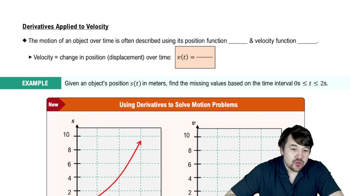
Derivatives Applied To Velocity

Derivative and Rate of Change

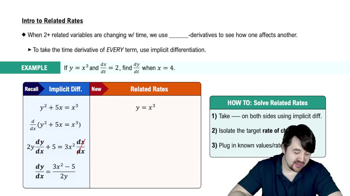
The derivative of the function A(t) represents the rate of change of the city's area with respect to time. By calculating A'(t), we can determine how fast the city is growing at any given time. This concept is essential for finding the growth rate when the city reaches a specific size, such as 38 mi², as it allows us to evaluate the instantaneous growth at that point.
Recommended video:
Guided course
04:16
Intro To Related Rates

Solving for Specific Values

To find out how fast the city is growing when it reaches 38 mi², we first need to solve the equation A(t) = 38 for t. This involves setting the function equal to 38 and solving for the time variable t. Once we have the appropriate value of t, we can substitute it back into the derivative A'(t) to find the growth rate at that specific moment.
Recommended video:
Guided course
05:03
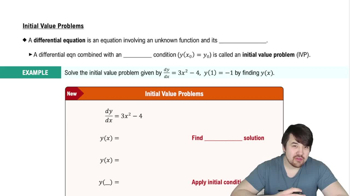
Initial Value Problems
Related Practice
Textbook Question

97–100. Logistic growth Scientists often use the logistic growth function P(t) = P₀K / P₀+(K−P₀)e^−r₀t to model population growth, where P₀ is the initial population at time t=0, K is the carrying capacity, and r₀ is the base growth rate. The carrying capacity is a theoretical upper bound on the total population that the surrounding environment can support. The figure shows the sigmoid (S-shaped) curve associated with a typical logistic model. <IMAGE>


{Use of Tech} Gone fishing When a reservoir is created by a new dam, 50 fish are introduced into the reservoir, which has an estimated carrying capacity of 8000 fish. A logistic model of the fish population is P(t) = 400,000 / 50+7950e^−0.5t, where t is measured in years.


b. How long does it take for the population to reach 5000 fish? How long does it take for the population to reach 90% of the carrying capacity?

170
views
Textbook Question

A race Jean and Juan run a one-lap race on a circular track. Their angular positions on the track during the race are given by the functions θ(t) and ϕ(t), respectively, where 0≤t≤4 and t is measured in minutes (see figure). These angles are measured in radians, where θ=ϕ=0 represent the starting position and θ=ϕ=2π represent the finish position. The angular velocities of the runners are θ′(t) and ϕ′(t). <IMAGE>

b. Which runner has the greater average angular velocity?

278
views
Textbook Question

Consider the following cost functions.

b. Determine the average cost and the marginal cost when x=a.

C(x) = − 0.01x²+40x+100, 0≤x≤1500, a=1000

248
views
Textbook Question

Deriving trigonometric identities

b. Verify that you obtain the same identity for sin2t as in part (a) if you differentiate the identity cos 2t = 2 cos² t−1.

374
views
Textbook Question

58–59. Carry out the following steps.

b. Find the slope of the curve at the given point.

xy^5/2+x^3/2y=12; (4, 1)

310
views
Textbook Question

45–50. Tangent lines Carry out the following steps. <IMAGE>

b. Determine an equation of the line tangent to the curve at the given point.

x⁴-x²y+y⁴=1; (−1, 1)

220
views