Ch. 5 - Integration
Briggs - Calculus: Early Transcendentals 3rd Edition
Briggs3rd EditionCalculus: Early TranscendentalsISBN: 9780136847243Not the one you use?Change textbook
Chapter 5, Problem 5.3.43

Definite integrals Evaluate the following integrals using the Fundamental Theorem of Calculus


∫₋₂⁻¹ 𝓍⁻³ d𝓍

Verified step by step guidance
1
Step 1: Recall the Fundamental Theorem of Calculus, which states that if a function f(x) is continuous on [a, b] and F(x) is its antiderivative, then ∫ₐᵇ f(x) dx = F(b) - F(a).
Step 2: Identify the integrand, which is x⁻³ (or 1/x³). The goal is to find its antiderivative. Rewrite the integrand as x⁻³ for clarity.
Step 3: Compute the antiderivative of x⁻³. Using the power rule for integration, ∫xⁿ dx = (xⁿ⁺¹)/(n+1) + C, where n ≠ -1. For x⁻³, n = -3, so the antiderivative becomes -1/(2x²).
Step 4: Apply the limits of integration, -2 and -1, to the antiderivative. Substitute x = -1 and x = -2 into the antiderivative expression, F(x) = -1/(2x²).
Step 5: Calculate the difference F(-1) - F(-2) to evaluate the definite integral. This step involves substituting the values and simplifying the result.

Verified video answer for a similar problem:

This video solution was recommended by our tutors as helpful for the problem above.
Video duration:
2m
Was this helpful?

Key Concepts

Here are the essential concepts you must grasp in order to answer the question correctly.

Definite Integrals

Definite integrals represent the signed area under a curve between two specified limits on the x-axis. They are denoted as ∫[a, b] f(x) dx, where 'a' and 'b' are the lower and upper limits, respectively. The value of a definite integral provides a numerical result that quantifies the accumulation of quantities, such as area, over the interval [a, b].
Recommended video:
05:43
Definition of the Definite Integral

Fundamental Theorem of Calculus

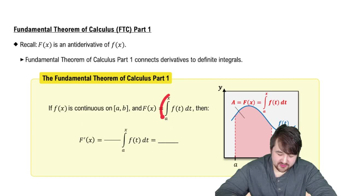
The Fundamental Theorem of Calculus links the concept of differentiation with integration, stating that if F is an antiderivative of f on an interval [a, b], then ∫[a, b] f(x) dx = F(b) - F(a). This theorem allows us to evaluate definite integrals by finding the antiderivative of the integrand and calculating its values at the limits of integration.
Recommended video:
06:11
Fundamental Theorem of Calculus Part 1

Antiderivatives

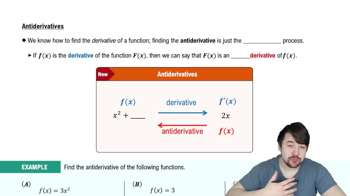
An antiderivative of a function f(x) is another function F(x) such that F'(x) = f(x). Finding an antiderivative is essential for evaluating definite integrals using the Fundamental Theorem of Calculus. For example, if f(x) = x^n, the antiderivative is F(x) = (x^(n+1))/(n+1) + C, where C is a constant. Understanding how to find antiderivatives is crucial for solving integral problems.
Recommended video:
05:50
Antiderivatives
Related Practice
Textbook Question

Identifying definite integrals as limits of sums Consider the following limits of Riemann sums for a function ƒ on [a,b]. Identify ƒ and express the limit as a definite integral.                                

          n                                                                                                                                                                              

    lim   ∑   𝓍*ₖ (ln 𝓍*ₖ) ∆𝓍ₖ on [1,2]                                                                                                                                                                            

  ∆ → 0   k=1                                                                                                                                                                                                                      

77
views
Textbook Question

Definite integrals Use a change of variables or Table 5.6 to evaluate the following definite integrals.                                                                                                                         


 ∫₁³ ( 2ˣ / 2ˣ + 4 ) d𝓍

42
views
Textbook Question

Definite integrals Use a change of variables or Table 5.6 to evaluate the following definite integrals.                                                                                                                         


 ∫π/₄^π/² (cos 𝓍) / (sin² 𝓍) d𝓍

70
views
Textbook Question

Symmetry in integrals Use symmetry to evaluate the following integrals.

∫₋π/₄^π/⁴ sec² x dx

95
views
Textbook Question

Indefinite integrals Use a change of variables or Table 5.6 to evaluate the following indefinite integrals. Check your work by differentiating.                                                                                  


 ∫ d𝓍 / (√1 ― 9𝓍²)

92
views
Textbook Question

Symmetry in integrals Use symmetry to evaluate the following integrals.

∫₋π/₂^π/² 5 sin θ dθ

245
views