
Ch. 7 - Logarithmic, Exponential Functions, and Hyperbolic Functions
Briggs - Calculus: Early Transcendentals 3rd Edition
Briggs3rd EditionCalculus: Early TranscendentalsISBN: 9780136847243Not the one you use?Change textbook
Chapter 7, Problem 7.3.37

37–56. Integrals Evaluate each integral.
∫ cosh 2x dx

Verified step by step guidance
1
Recall the definition of the hyperbolic cosine function: \(\cosh x = \frac{e^x + e^{-x}}{2}\).
Use the double angle identity for hyperbolic cosine: \(\cosh 2x = 2\cosh^2 x - 1\) or express \(\cosh 2x\) in terms of exponentials as \(\frac{e^{2x} + e^{-2x}}{2}\).
Rewrite the integral using the exponential form: \(\int \cosh 2x \, dx = \int \frac{e^{2x} + e^{-2x}}{2} \, dx\).
Split the integral into two simpler integrals: \(\frac{1}{2} \int e^{2x} \, dx + \frac{1}{2} \int e^{-2x} \, dx\).
Integrate each term using the formula \(\int e^{ax} \, dx = \frac{1}{a} e^{ax} + C\), then combine the results and add the constant of integration.

Verified video answer for a similar problem:

This video solution was recommended by our tutors as helpful for the problem above.
Video duration:
1m
Was this helpful?

Key Concepts

Here are the essential concepts you must grasp in order to answer the question correctly.

Hyperbolic Functions

Hyperbolic functions, such as cosh(x) and sinh(x), are analogs of trigonometric functions but based on exponential functions. Specifically, cosh(x) = (e^x + e^(-x))/2. Understanding their definitions and properties is essential for integrating expressions involving cosh.
Recommended video:
5:50
Asymptotes of Hyperbolas

Integration of Exponential Functions

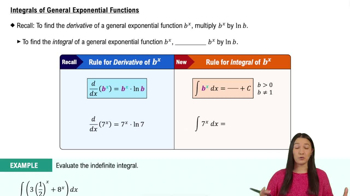
Since hyperbolic functions are expressed in terms of exponentials, integrating cosh(2x) involves integrating exponential functions like e^(2x). The integral of e^(ax) with respect to x is (1/a)e^(ax) + C, which helps in solving the integral of cosh(2x).
Recommended video:
05:11
Integrals of General Exponential Functions

Use of Substitution in Integration

When integrating functions like cosh(2x), substitution is useful to simplify the integral. Letting u = 2x transforms the integral into a simpler form, allowing the use of standard integration rules and then substituting back to the original variable.
Recommended video:
04:27
Substitution With an Extra Variable
Related Practice
Textbook Question

Tsunamis A tsunami is an ocean wave often caused by earthquakes on the ocean floor; these waves typically have long wavelengths, ranging from 150 to 1000 km. Imagine a tsunami traveling across the Pacific Ocean, which is the deepest ocean in the world, with an average depth of about 4000 m. Explain why the shallow-water velocity equation (Exercise 75) applies to tsunamis even though the actual depth of the water is large. What does the shallow-water equation say about the speed of a tsunami in the Pacific Ocean (use d = 4000 m)?

67
views
Textbook Question

Probability as an integral Two points P and Q are chosen randomly, one on each of two adjacent sides of a unit square (see figure). What is the probability that the area of the triangle formed by the sides of the square and the line segment PQ is less than one-fourth the area of the square? Begin by showing that x and y must satisfy xy < 1/2 in order for the area condition to be met. Then argue that the required probability is: 1/2 + ∫[1/2 to 1] (dx / 2x) and evaluate the integral.

58
views
Textbook Question

Rule of 70 Bankers use the Rule of 70, which says that if an account increases at a fixed rate of p%/yr, its doubling time is approximately 70/p. Use linear approximation to explain why and when this is true.

71
views
Textbook Question

11–15. Identities Prove each identity using the definitions of the hyperbolic functions.


tanh(−x) = −tanh x

91
views
Textbook Question

Newton’s method Use Newton’s method to find all local extreme values of ƒ(x) = x sech x.

65
views
Textbook Question

22–36. Derivatives Find the derivatives of the following functions.


f(t) = 2 tanh⁻¹ √t

72
views