Ch. 7 - Logarithmic, Exponential Functions, and Hyperbolic Functions
Briggs - Calculus: Early Transcendentals 3rd Edition
Briggs3rd EditionCalculus: Early TranscendentalsISBN: 9780136847243Not the one you use?Change textbook
Chapter 7, Problem 7.3.78f

Evaluating hyperbolic functions Use a calculator to evaluate each expression or state that the value does not exist. Report answers accurate to four decimal places to the right of the decimal point.
f. tan⁻¹(sinh x) |₋₃³

Verified step by step guidance
1
Recall that the function given is the inverse tangent of the hyperbolic sine function, written as \(\tan^{-1}(\sinh x)\). This means we first need to evaluate \(\sinh x\) at the given bounds and then apply the inverse tangent function to those results.
Write down the definition of the hyperbolic sine function: \(\sinh x = \frac{e^{x} - e^{-x}}{2}\). This will help you calculate \(\sinh x\) at \(x = -3\) and \(x = 3\).
Calculate \(\sinh(-3)\) and \(\sinh(3)\) using the formula from step 2. Remember that \(\sinh\) is an odd function, so \(\sinh(-3) = -\sinh(3)\), which can simplify your calculations.
Next, apply the inverse tangent function \(\tan^{-1}\) to the values of \(\sinh(-3)\) and \(\sinh(3)\) you found. This means you will find \(\tan^{-1}(\sinh(-3))\) and \(\tan^{-1}(\sinh(3))\).
Finally, evaluate the definite expression \(\tan^{-1}(\sinh x) \big|_{-3}^{3}\) by subtracting the value at \(x = -3\) from the value at \(x = 3\): \(\tan^{-1}(\sinh 3) - \tan^{-1}(\sinh (-3))\). Use a calculator to find these values accurate to four decimal places.

Verified video answer for a similar problem:

This video solution was recommended by our tutors as helpful for the problem above.
Video duration:
4m
Was this helpful?

Key Concepts

Here are the essential concepts you must grasp in order to answer the question correctly.

Hyperbolic Functions

Hyperbolic functions, such as sinh(x), cosh(x), and tanh(x), are analogs of trigonometric functions but based on hyperbolas. Sinh(x) is defined as (e^x - e^(-x))/2 and can take any real value. Understanding their properties is essential for evaluating expressions involving these functions.
Recommended video:
5:50
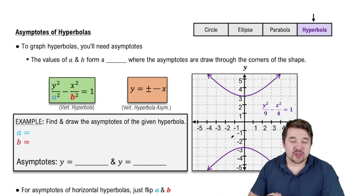
Asymptotes of Hyperbolas

Inverse Trigonometric Functions

The inverse tangent function, tan⁻¹(x), returns the angle whose tangent is x, with a range of (-π/2, π/2). It is important to know how to apply inverse trig functions to real numbers and interpret their outputs, especially when composed with other functions like sinh(x).
Recommended video:
06:35
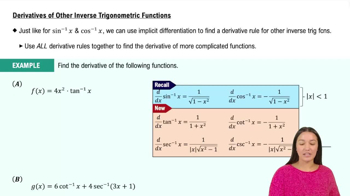
Derivatives of Other Inverse Trigonometric Functions

Definite Evaluation and Calculator Use

Evaluating an expression like tan⁻¹(sinh x) |₋₃³ requires substituting the limits into the function and computing values accurately, often using a calculator. Reporting answers to four decimal places demands careful rounding and understanding of function domains to ensure the values exist and are valid.
Recommended video:
05:43
Definition of the Definite Integral