Ch. 8 - Integration Techniques
Briggs - Calculus: Early Transcendentals 3rd Edition
Briggs3rd EditionCalculus: Early TranscendentalsISBN: 9780136847243Not the one you use?Change textbook
Chapter 8, Problem 8.R.9

2–74. Integration techniques Use the methods introduced in Sections 8.1 through 8.5 to evaluate the following integrals.
9. ∫ (from 0 to π/4) cos⁵ 2x sin² 2x dx

Verified step by step guidance
1
Step 1: Recognize that the integral involves powers of trigonometric functions. Use trigonometric identities to simplify the expression. Specifically, use the identity sin²θ = 1 - cos²θ to rewrite sin² 2x.
Step 2: Rewrite the integral using substitution. Let u = cos 2x, which implies du = -2 sin 2x dx. Adjust the integral accordingly to account for this substitution.
Step 3: Change the limits of integration to match the substitution. When x = 0, u = cos 0 = 1. When x = π/4, u = cos π/2 = 0. Update the integral limits accordingly.
Step 4: Simplify the integral in terms of u. The integral becomes a polynomial in u, which can be integrated using standard techniques for polynomial integration.
Step 5: After integrating, substitute back the original variable x and evaluate the definite integral using the updated limits. This will yield the final result.

Verified video answer for a similar problem:

This video solution was recommended by our tutors as helpful for the problem above.
Video duration:
4m
Was this helpful?

Key Concepts

Here are the essential concepts you must grasp in order to answer the question correctly.

Integration Techniques

Integration techniques are methods used to evaluate integrals that may not be solvable by basic antiderivatives. Common techniques include substitution, integration by parts, and trigonometric identities. Understanding these methods is crucial for simplifying complex integrals into manageable forms.
Recommended video:
06:18
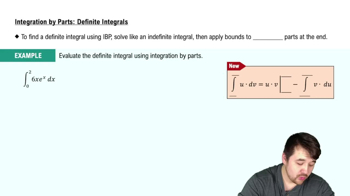
Integration by Parts for Definite Integrals

Trigonometric Identities

Trigonometric identities are equations involving trigonometric functions that are true for all values of the variables. They can be used to simplify integrals involving sine and cosine functions. For example, using identities like sin²(x) + cos²(x) = 1 can help rewrite integrals in a more solvable format.
Recommended video:
7:17
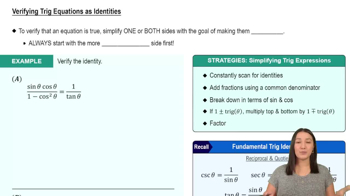
Verifying Trig Equations as Identities

Definite Integrals

Definite integrals represent the area under a curve between two specified limits. They are calculated using the Fundamental Theorem of Calculus, which connects differentiation and integration. Understanding how to evaluate definite integrals is essential for finding exact values of integrals over a given interval.
Recommended video:
05:43
Definition of the Definite Integral