Ch. 8 - Integration Techniques
Briggs - Calculus: Early Transcendentals 3rd Edition
Briggs3rd EditionCalculus: Early TranscendentalsISBN: 9780136847243Not the one you use?Change textbook
Chapter 8, Problem 8.R.18

2–74. Integration techniques Use the methods introduced in Sections 8.1 through 8.5 to evaluate the following integrals.
18. ∫ (from 0 to √2) (x + 1)/(3x² + 6) dx

Verified step by step guidance
1
Step 1: Simplify the integrand. Start by factoring the denominator: \(3x^2 + 6 = 3(x^2 + 2)\). Rewrite the integrand as \(\frac{x + 1}{3(x^2 + 2)}\).
Step 2: Split the integrand into two separate terms: \(\frac{x}{3(x^2 + 2)} + \frac{1}{3(x^2 + 2)}\). This allows us to handle each term individually.
Step 3: For the first term \(\frac{x}{3(x^2 + 2)}\), notice that the numerator is the derivative of the denominator \(x^2 + 2\). Use the substitution method: let \(u = x^2 + 2\), then \(du = 2x dx\). Adjust for the constant and rewrite the integral.
Step 4: For the second term \(\frac{1}{3(x^2 + 2)}\), recognize it as a standard integral form. Use the formula \(\int \frac{1}{a^2 + x^2} dx = \frac{1}{a} \arctan\left(\frac{x}{a}\right)\), where \(a = \sqrt{2}\). Apply this formula to evaluate the integral.
Step 5: Combine the results of both integrals and evaluate the definite integral by substituting the limits \(x = 0\) and \(x = \sqrt{2}\). Simplify the expression to obtain the final result.

Verified video answer for a similar problem:

This video solution was recommended by our tutors as helpful for the problem above.
Video duration:
6m
Was this helpful?

Key Concepts

Here are the essential concepts you must grasp in order to answer the question correctly.

Integration Techniques

Integration techniques are methods used to find the integral of a function. Common techniques include substitution, integration by parts, and partial fraction decomposition. Understanding these methods is crucial for evaluating complex integrals, as they allow for simplification and easier computation.
Recommended video:
06:18
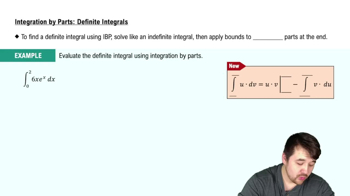
Integration by Parts for Definite Integrals

Definite Integrals

A definite integral calculates the area under a curve between two specified limits. It is represented as ∫ from a to b f(x) dx, where 'a' and 'b' are the bounds of integration. Evaluating definite integrals involves finding the antiderivative of the function and applying the Fundamental Theorem of Calculus.
Recommended video:
05:43
Definition of the Definite Integral

Rational Functions

Rational functions are ratios of polynomials, expressed as f(x) = P(x)/Q(x), where P and Q are polynomials. When integrating rational functions, techniques such as polynomial long division and partial fraction decomposition are often employed to simplify the integrand, making it easier to integrate.
Recommended video:
6:04
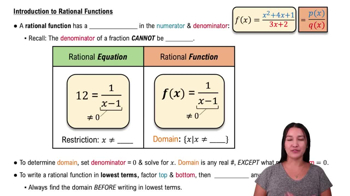
Intro to Rational Functions