Ch. 8 - Integration Techniques
Briggs - Calculus: Early Transcendentals 3rd Edition
Briggs3rd EditionCalculus: Early TranscendentalsISBN: 9780136847243Not the one you use?Change textbook
Chapter 8, Problem 8.8.60

58–61. {Use of Tech} Using Simpson's Rule Approximate the following integrals using Simpson's Rule. Experiment with values of n to ensure the error is less than 10⁻³.
60. ∫(from 0 to π) ln(2 + cos x) dx = π ln((2 + √3)/2)

Verified step by step guidance
1
Identify the integral to approximate: \(\int_0^{\pi} \ln(2 + \cos x) \, dx\).
Recall Simpson's Rule formula for approximating an integral over \([a,b]\) with \(n\) subintervals (where \(n\) is even): \[\int_a^b f(x) \, dx \approx \frac{\Delta x}{3} \left[f(x_0) + 4 \sum_{i=1, \text{odd}}^{n-1} f(x_i) + 2 \sum_{i=2, \text{even}}^{n-2} f(x_i) + f(x_n)\right]\] where \(\Delta x = \frac{b - a}{n}\) and \(x_i = a + i \Delta x\).
Choose an initial even value for \(n\) (e.g., \(n=4\) or \(n=6\)) and compute the partition points \(x_i\) from \(0\) to \(\pi\) with spacing \(\Delta x = \frac{\pi}{n}\).
Evaluate the function \(f(x) = \ln(2 + \cos x)\) at each partition point \(x_i\) and substitute these values into Simpson's Rule formula to get an approximate value of the integral.
Increase \(n\) (e.g., double it) and repeat the approximation until the difference between successive approximations is less than \$10^{-3}$, ensuring the error tolerance is met.

Verified video answer for a similar problem:

This video solution was recommended by our tutors as helpful for the problem above.
Video duration:
6m
Was this helpful?

Key Concepts

Here are the essential concepts you must grasp in order to answer the question correctly.

Simpson's Rule

Simpson's Rule is a numerical method for approximating definite integrals by dividing the interval into an even number of subintervals and fitting quadratic polynomials to the function. It provides higher accuracy than the trapezoidal rule for smooth functions by using parabolic arcs instead of straight lines.
Recommended video:

Error Estimation in Numerical Integration

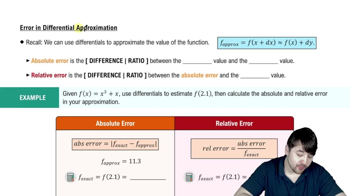
Error estimation helps determine how close the numerical approximation is to the true value of the integral. For Simpson's Rule, the error depends on the fourth derivative of the function and the number of subintervals n, allowing adjustment of n to ensure the error is below a specified tolerance, such as 10⁻³.
Recommended video:
04:57
Determining Error and Relative Error

Properties of the Given Integral and Function

Understanding the behavior of the integrand ln(2 + cos x) over [0, π] is important for applying Simpson's Rule effectively. The function is continuous and smooth on this interval, which justifies using Simpson's Rule and helps in estimating derivatives needed for error bounds.
Recommended video:
06:21
Properties of Functions