Ch. 8 - Integration Techniques
Briggs - Calculus: Early Transcendentals 3rd Edition
Briggs3rd EditionCalculus: Early TranscendentalsISBN: 9780136847243Not the one you use?Change textbook
Chapter 8, Problem 8.9.63

63. Average Lifetime The average time until a computer chip fails (see Exercise 62) is 0.00005 ∫(from 0 to ∞) t e^(-0.00005t) dt. Find this value.

Verified step by step guidance
1
Recognize that the problem asks for the average lifetime, which is given by the integral \(0.00005 \int_0^{\infty} t e^{-0.00005 t} \, dt\). This is an expected value calculation for a continuous random variable with probability density function proportional to \(e^{-\lambda t}\), where \(\lambda = 0.00005\).
Recall the formula for the expected value of an exponential distribution: if \(X\) has PDF \(f(t) = \lambda e^{-\lambda t}\) for \(t \geq 0\), then \(E[X] = \int_0^{\infty} t \lambda e^{-\lambda t} \, dt = \frac{1}{\lambda}\).
Identify that the integral inside the problem matches the form \(\int_0^{\infty} t e^{-\lambda t} \, dt\), but the problem includes the factor \(0.00005\) outside the integral, which corresponds to \(\lambda\).
Use integration by parts to verify the integral \(\int_0^{\infty} t e^{-\lambda t} \, dt\): let \(u = t\) and \(dv = e^{-\lambda t} dt\), then compute \(du\) and \(v\), and apply the integration by parts formula \(\int u \, dv = uv - \int v \, du\).
After evaluating the integral, multiply the result by \(0.00005\) as given, and simplify to find the average lifetime value.

Verified video answer for a similar problem:

This video solution was recommended by our tutors as helpful for the problem above.
Video duration:
2m
Was this helpful?

Key Concepts

Here are the essential concepts you must grasp in order to answer the question correctly.

Expected Value of a Continuous Random Variable

The expected value (or mean) of a continuous random variable is calculated as the integral of the variable multiplied by its probability density function over its entire range. It represents the average or mean outcome one would expect over many trials.
Recommended video:
05:34
Intro to Continuity

Exponential Distribution and Its PDF

The exponential distribution models the time between events in a Poisson process and has a probability density function (PDF) of the form λe^(-λt) for t ≥ 0. It is often used to model lifetimes or waiting times, where λ is the rate parameter.
Recommended video:
6:13
Exponential Functions

Integration by Parts

Integration by parts is a technique used to integrate products of functions. It is based on the formula ∫u dv = uv - ∫v du and is useful for solving integrals involving polynomials multiplied by exponentials, such as t e^(-at).
Recommended video:
06:18
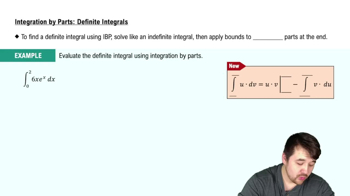
Integration by Parts for Definite Integrals