Ch. 8 - Integration Techniques
Briggs - Calculus: Early Transcendentals 3rd Edition
Briggs3rd EditionCalculus: Early TranscendentalsISBN: 9780136847243Not the one you use?Change textbook
Chapter 8, Problem 8.9.16

7–58. Improper integrals Evaluate the following integrals or state that they diverge.
16. ∫ (from -∞ to ∞) (1/(x² + a²)) dx, a > 0

Verified step by step guidance
1
Recognize that the integral is an improper integral over the entire real line from \(-\infty\) to \(\infty\) of the function \(\frac{1}{x^{2} + a^{2}}\), where \(a > 0\).
Since the integral is over an infinite interval, rewrite it as a limit: \(\displaystyle \int_{-\infty}^{\infty} \frac{1}{x^{2} + a^{2}} \, dx = \lim_{R \to \infty} \int_{-R}^{R} \frac{1}{x^{2} + a^{2}} \, dx\).
Use the fact that the integrand is an even function, meaning \(f(-x) = f(x)\), so the integral from \(-R\) to \(R\) can be expressed as twice the integral from \(0\) to \(R\): \(\int_{-R}^{R} \frac{1}{x^{2} + a^{2}} \, dx = 2 \int_{0}^{R} \frac{1}{x^{2} + a^{2}} \, dx\).
Recall the antiderivative formula: \(\int \frac{1}{x^{2} + a^{2}} \, dx = \frac{1}{a} \arctan\left( \frac{x}{a} \right) + C\). Use this to evaluate the definite integral from \(0\) to \(R\).
Substitute the limits into the antiderivative, multiply by 2, and then take the limit as \(R \to \infty\) to determine whether the integral converges or diverges.

Verified video answer for a similar problem:

This video solution was recommended by our tutors as helpful for the problem above.
Video duration:
7m
Was this helpful?

Key Concepts

Here are the essential concepts you must grasp in order to answer the question correctly.

Improper Integrals

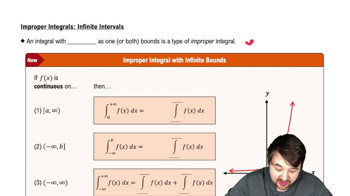
Improper integrals involve integration over infinite intervals or integrands with infinite discontinuities. To evaluate them, limits are used to approach the problematic points, determining if the integral converges to a finite value or diverges.
Recommended video:
11:11
Improper Integrals: Infinite Intervals

Integration of Rational Functions

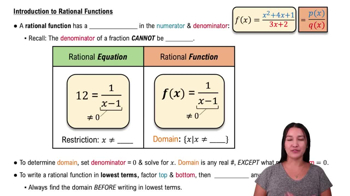
Rational functions are ratios of polynomials. Integrals of the form 1/(x² + a²) are standard and often solved using inverse trigonometric functions, specifically the arctangent, which helps in finding antiderivatives for such expressions.
Recommended video:
6:04
Intro to Rational Functions

Convergence of Integrals over Infinite Limits

When integrating over infinite limits, it is essential to check if the integral converges by evaluating the limit of the integral as the bounds approach infinity. For functions like 1/(x² + a²), the integral converges due to the function's decay rate.
Recommended video:
11:11
Improper Integrals: Infinite Intervals