Ch. 8 - Integration Techniques
Briggs - Calculus: Early Transcendentals 3rd Edition
Briggs3rd EditionCalculus: Early TranscendentalsISBN: 9780136847243Not the one you use?Change textbook
Chapter 8, Problem 8.6.13

7–84. Evaluate the following integrals.
13. ∫ [1 / (eˣ √(1 – e²ˣ))] dx

Verified step by step guidance
1
Step 1: Recognize that the integral involves a composite function. The term √(1 - e²ˣ) suggests a substitution might simplify the expression. Let u = eˣ, which implies du = eˣ dx.
Step 2: Rewrite the integral in terms of u. Substituting u = eˣ, dx = du / u. The integral becomes ∫ [1 / (u √(1 - u²))] * (du / u). Simplify the expression to ∫ [1 / (u² √(1 - u²))] du.
Step 3: Notice that the integral now resembles a standard form involving √(1 - u²). This suggests a trigonometric substitution. Let u = sin(θ), which implies du = cos(θ) dθ and √(1 - u²) = √(1 - sin²(θ)) = cos(θ).
Step 4: Substitute u = sin(θ) into the integral. The expression becomes ∫ [1 / (sin²(θ) * cos(θ))] * cos(θ) dθ. Simplify to ∫ [1 / sin²(θ)] dθ.
Step 5: Use the identity 1 / sin²(θ) = csc²(θ). The integral becomes ∫ csc²(θ) dθ, which is a standard integral. The result of this integral is -cot(θ) + C. Finally, back-substitute θ = arcsin(u) and u = eˣ to express the solution in terms of x.

Verified video answer for a similar problem:

This video solution was recommended by our tutors as helpful for the problem above.
Video duration:
8m
Was this helpful?

Key Concepts

Here are the essential concepts you must grasp in order to answer the question correctly.

Integration

Integration is a fundamental concept in calculus that involves finding the accumulated area under a curve represented by a function. It is the reverse process of differentiation and can be used to calculate quantities such as areas, volumes, and total accumulated change. Understanding the techniques of integration, such as substitution and integration by parts, is essential for evaluating integrals.
Recommended video:
06:18
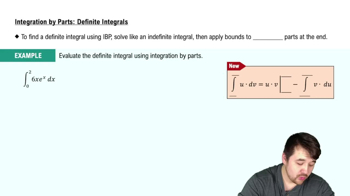
Integration by Parts for Definite Integrals

Substitution Method

The substitution method is a technique used in integration to simplify the process by changing the variable of integration. By substituting a part of the integrand with a new variable, the integral can often be transformed into a more manageable form. This method is particularly useful when dealing with composite functions or when the integrand contains a function and its derivative.
Recommended video:
07:33
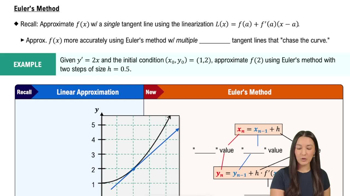
Euler's Method

Exponential Functions

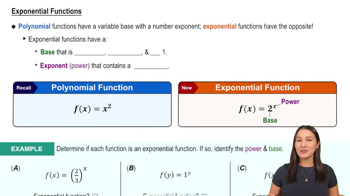
Exponential functions, such as eˣ, are functions of the form f(x) = a^x, where 'a' is a constant. These functions have unique properties, including a constant rate of growth and a derivative that is proportional to the function itself. In the context of the given integral, understanding the behavior of exponential functions and their relationship with other functions is crucial for evaluating the integral effectively.
Recommended video:
6:13
Exponential Functions