
Textbook Question
Cartesian to Polar Equations
Replace the Cartesian equations in Exercises 53–66 with equivalent polar equations.
x - y = 3
44
views

 Verified step by step guidance
 08:02
08:02
 04:50
04:50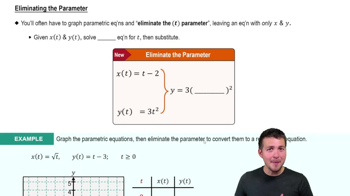 05:59
05:59Cartesian to Polar Equations
Replace the Cartesian equations in Exercises 53–66 with equivalent polar equations.
x - y = 3
Polar to Cartesian Equations
Replace the polar equations in Exercises 27–52 with equivalent Cartesian equations. Then describe or identify the graph.
r² = 4r sin θ
Finding Parametric Equations
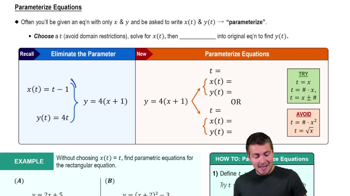
In Exercises 31–36, find a parametrization for the curve.
the ray (half line) with initial point (-1,2) that passes through the point (0,0)
Finding Cartesian from Parametric Equations
Exercises 1–18 give parametric equations and parameter intervals for the motion of a particle in the xy-plane. Identify the particle’s path by finding a Cartesian equation for it. Graph the Cartesian equation. (The graphs will vary with the equation used.) Indicate the portion of the graph traced by the particle and the direction of motion.
x = 1 + sin t, y = cos t − 2, 0 ≤ t ≤ π
Symmetries and Polar Graphs
Identify the symmetries of the curves in Exercises 1–12. Then sketch the curves in the xy-plane.
r = 1 + 2 sin θ
Finding Polar Areas
Find the areas of the regions in Exercises 9–18.
Inside the circle r = 4 sin θ and below the horizontal line r = 3 csc θ