Ch. 4 - Applications of Derivatives
Hass - Thomas' Calculus 15th Edition
Hass15th EditionThomas' CalculusISBN: 9780137616077Not the one you use?Change textbook
Chapter 4, Problem 4.7.41

Finding Indefinite Integrals


In Exercises 17–56, find the most general antiderivative or indefinite integral. You may need to try a solution and then adjust your guess. Check your answers by differentiation.


∫(cscθ cotθ) / 2 dθ

Verified step by step guidance
1
Recognize that the integral is \( \int \frac{\csc \theta \cot \theta}{2} \, d\theta \). Since the constant \( \frac{1}{2} \) can be factored out, rewrite the integral as \( \frac{1}{2} \int \csc \theta \cot \theta \, d\theta \).
Recall the derivative of \( \csc \theta \) is \( -\csc \theta \cot \theta \). This suggests that \( \csc \theta \cot \theta \) is closely related to the derivative of \( \csc \theta \).
Use this relationship to guess that the antiderivative of \( \csc \theta \cot \theta \) is \( -\csc \theta \), because differentiating \( -\csc \theta \) gives \( \csc \theta \cot \theta \).
Therefore, the integral becomes \( \frac{1}{2} \times (-\csc \theta) + C \), where \( C \) is the constant of integration.
Finally, verify your result by differentiating \( -\frac{1}{2} \csc \theta + C \) to ensure it matches the original integrand \( \frac{\csc \theta \cot \theta}{2} \).

Verified video answer for a similar problem:

This video solution was recommended by our tutors as helpful for the problem above.
Video duration:
1m
Was this helpful?

Key Concepts

Here are the essential concepts you must grasp in order to answer the question correctly.

Indefinite Integral and Antiderivative

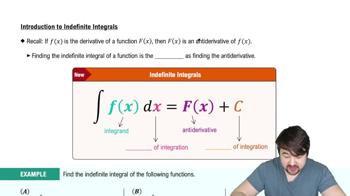
An indefinite integral represents the most general form of an antiderivative of a function, including a constant of integration. It reverses differentiation, finding a function whose derivative matches the integrand. Understanding this helps in solving integrals without specified limits.
Recommended video:
05:04
Introduction to Indefinite Integrals

Trigonometric Functions and Identities

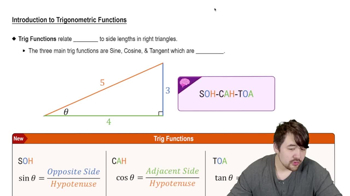
Knowledge of trigonometric functions like cosecant (csc) and cotangent (cot), and their relationships, is essential. Recognizing identities such as the derivative of cscθ being -cscθ cotθ aids in simplifying and integrating expressions involving these functions.
Recommended video:
6:04
Introduction to Trigonometric Functions

Verification by Differentiation

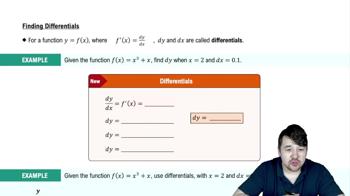
After finding an antiderivative, differentiating it confirms the correctness of the integral. This step ensures the solution is accurate and helps identify any errors in the integration process, reinforcing understanding of the fundamental theorem of calculus.
Recommended video:
05:53
Finding Differentials
Related Practice
Textbook Question

Theory and Examples


Maximum height of a vertically moving body The height of a body moving vertically is given by s = −12gt² + υ₀t + s₀,  g > 0, with s in meters and t in seconds. Find the body’s maximum height.

209
views
Textbook Question

Business and Economics

62. Production level Suppose that c(x)=x^3-20x^2 + 20,000x is the cost of manufacturing x items. Find a production level that will minimize the average cost of making x items.

182
views
Textbook Question

56. Airplane landing path An airplane is flying at altitude H when it begins its descent to an airport runway that is at horizontal ground distance L from the airplane, as shown in the accompanying figure. Assume that the landing path of the airplane is the graph of a cubic polynomial function y = ax^3+bx^2+cx+d, where y(-L)= H and y(0)=0.

a. What is dy/dx at x = 0?

b. What is dy/dx at x = -L?

c. Use the values for dy/dx at x = 0 and x =- L together with y(0) = 0 and y(-L) = H to show that y(x)=H[2(x/L)^3+3(x/L)^2]

158
views
Textbook Question

The 8-ft wall shown here stands 27 ft from the building. Find the length of the shortest straight beam that will reach to the side of the building from the ground outside the wall.

211
views
Textbook Question

Finding Indefinite Integrals


In Exercises 17–56, find the most general antiderivative or indefinite integral. You may need to try a solution and then adjust your guess. Check your answers by differentiation.


∫(−3csc²x)dx

17
views
Textbook Question

Initial Value Problems

Solve the initial value problems in Exercises 71–90.

d³y/dx³ = 6; y″(0) = −8, y′(0) = 0, y(0) = 5

14
views