Ch. 7 - Transcendental Functions
Hass - Thomas' Calculus 15th Edition
Hass15th EditionThomas' CalculusISBN: 9780137616077Not the one you use?Change textbook
Chapter 7, Problem 7.3.5

5. e^(2t)-3e^t = 0

Verified step by step guidance
1
Rewrite the equation \(e^{2t} - 3e^t = 0\) by recognizing that \(e^{2t}\) can be expressed as \((e^t)^2\). This allows us to treat the equation like a quadratic in terms of \(e^t\).
Let \(x = e^t\). Substitute this into the equation to get \(x^2 - 3x = 0\).
Factor the quadratic equation: \(x(x - 3) = 0\). This gives two possible solutions for \(x\): \(x = 0\) or \(x = 3\).
Recall that \(x = e^t\), and since \(e^t\) is never zero for any real \(t\), discard \(x = 0\). Focus on \(e^t = 3\).
Solve for \(t\) by taking the natural logarithm of both sides: \(t = \ln(3)\). This gives the solution for \(t\).

Verified video answer for a similar problem:

This video solution was recommended by our tutors as helpful for the problem above.
Video duration:
3m
Was this helpful?

Key Concepts

Here are the essential concepts you must grasp in order to answer the question correctly.

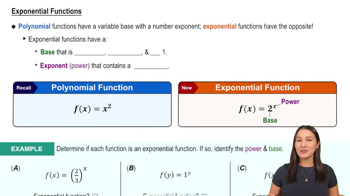
Exponential Functions

Exponential functions involve variables in the exponent, such as e^t. Understanding their properties, like how e^(a+b) = e^a * e^b, helps simplify and solve equations involving exponentials.
Recommended video:
6:13
Exponential Functions

Substitution Method

The substitution method replaces a complex expression with a simpler variable to transform the equation into a more familiar form, such as turning e^t into x, making it easier to solve.
Recommended video:
07:33
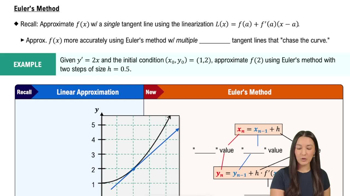
Euler's Method

Solving Quadratic Equations

After substitution, the equation often becomes quadratic. Knowing how to solve quadratic equations using factoring, the quadratic formula, or completing the square is essential to find the variable's values.
Recommended video:
5:02
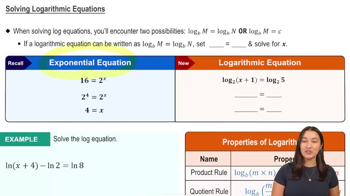
Solving Logarithmic Equations