Ch. 7 - Transcendental Functions
Hass - Thomas' Calculus 15th Edition
Hass15th EditionThomas' CalculusISBN: 9780137616077Not the one you use?Change textbook
Chapter 7, Problem 7.6.23

In Exercises 21–48, find the derivative of y with respect to the appropriate variable.
23. y=arcsin(√2t)

Verified step by step guidance
1
Identify the function to differentiate: \(y = \arcsin(\sqrt{2t})\) where the variable is \(t\).
Recall the derivative formula for the inverse sine function: \(\frac{d}{dx} \arcsin(u) = \frac{1}{\sqrt{1 - u^2}} \cdot \frac{du}{dx}\), where \(u\) is a function of \(x\).
Set \(u = \sqrt{2t} = (2t)^{1/2}\). Find the derivative of \(u\) with respect to \(t\): \(\frac{du}{dt} = \frac{1}{2} (2t)^{-1/2} \cdot 2\) using the chain rule.
Substitute \(u\) and \(\frac{du}{dt}\) into the derivative formula: \(\frac{dy}{dt} = \frac{1}{\sqrt{1 - (\sqrt{2t})^2}} \cdot \frac{du}{dt}\).
Simplify the expression inside the square root and the derivative to write the final derivative in terms of \(t\) (without calculating the numeric value).

Verified video answer for a similar problem:

This video solution was recommended by our tutors as helpful for the problem above.
Video duration:
2m

Key Concepts

Here are the essential concepts you must grasp in order to answer the question correctly.

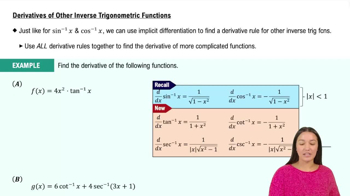
Derivative of Inverse Trigonometric Functions

The derivative of arcsin(x) with respect to x is 1 divided by the square root of (1 minus x squared), i.e., d/dx[arcsin(x)] = 1/√(1 - x²). This formula is essential when differentiating functions involving arcsin.
Recommended video:
06:35
Derivatives of Other Inverse Trigonometric Functions

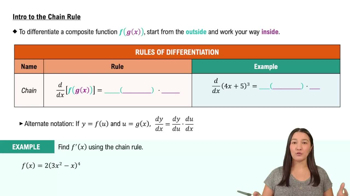
Chain Rule

The chain rule is used to differentiate composite functions. If y = f(g(t)), then dy/dt = f'(g(t)) * g'(t). Here, arcsin(√2t) is a composite function requiring the chain rule to differentiate the outer and inner functions.
Recommended video:
05:02
Intro to the Chain Rule

Derivative of Square Root Functions

The derivative of √u, where u is a function of t, is (1/(2√u)) * du/dt. Recognizing that √2t can be written as (2t)^(1/2) helps in applying the power rule combined with the chain rule.
Recommended video: