

Ch. 7 - Transcendental Functions
Hass - Thomas' Calculus 15th Edition
Hass15th EditionThomas' CalculusISBN: 9780137616077Not the one you use?Change textbook
Chapter 7, Problem 7.7.67b

Evaluate the integrals in Exercises 67–74 in terms of
b. natural logarithms.
67. ∫(from 0 to 2√3)dx/√(4+x²)

Verified step by step guidance
1
Recognize that the integral is of the form \(\int \frac{dx}{\sqrt{a^2 + x^2}}\), where \(a = 2\) in this case.
Recall the standard integral formula: \(\int \frac{dx}{\sqrt{a^2 + x^2}} = \ln \left| x + \sqrt{x^2 + a^2} \right| + C\).
Apply the definite integral limits from \(0\) to \(2\sqrt{3}\), so write the expression as \(\left[ \ln \left( x + \sqrt{x^2 + 4} \right) \right]_0^{2\sqrt{3}}\).
Evaluate the expression at the upper limit \(x = 2\sqrt{3}\) and at the lower limit \(x = 0\) separately.
Subtract the value at the lower limit from the value at the upper limit to get the final answer in terms of natural logarithms.

Verified video answer for a similar problem:

This video solution was recommended by our tutors as helpful for the problem above.
Video duration:
5m
Was this helpful?

Key Concepts

Here are the essential concepts you must grasp in order to answer the question correctly.

Definite Integrals

A definite integral calculates the net area under a curve between two specific limits. It involves evaluating the antiderivative at the upper and lower bounds and subtracting these values to find the exact accumulated quantity.
Recommended video:
Guided course
05:43
Definition of the Definite Integral

Integration of Functions Involving √(a² + x²)

Integrals of the form ∫dx/√(a² + x²) often use trigonometric substitution or recognize standard integral formulas. The antiderivative typically involves inverse hyperbolic functions or natural logarithms, such as ln|x + √(x² + a²)|.
Recommended video:
07:01
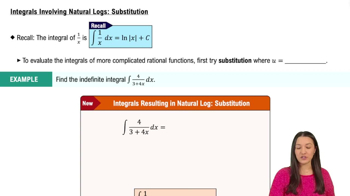
Integrals Involving Natural Logs: Substitution

Natural Logarithms in Integration

Natural logarithms frequently appear in integrals involving rational functions and roots. They provide a way to express antiderivatives of functions like 1/√(a² + x²), linking algebraic expressions to logarithmic forms for easier evaluation.
Recommended video:
05:18
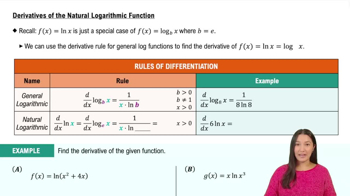
Derivative of the Natural Logarithmic Function
Related Practice
Textbook Question

31. The incidence of a disease (Continuation of Example 4.) Suppose that in any given year the number of cases can be reduced by 25% instead of 20%.

b. How long will it take to eradicate the disease—that is, reduce the number of cases to less than 1?

9
views
Textbook Question

In Exercises 67–72, you will explore some functions and their inverses together with their derivatives and tangent line approximations at specified points. Perform the following steps using your CAS:


b. Solve the equation y=f(x) for x as a function of y, and name the resulting inverse function g.

67. y= √(3x-2), 2/3 ≤ x ≤ 4, x_0=3

34
views
Textbook Question

78. Which one is correct, and which one is wrong? Give reasons for your answers.

a. lim (x → 0) (x² - 2x) / (x² - sin x) = lim (x → 0) (2x - 2) / (2x - cos x) = lim (x → 0) 2 / (2 + sin x) = 2 / (2 + 0) = 1

20
views
Textbook Question

[Technology Exercise] In Exercises 139–141, find the domain and range of each composite function. Then graph the compositions on separate screens. Do the graphs make sense in each case? Give reasons for your answers. Comment on any differences you see.

139. a. y=arctan(tan x)

31
views
Textbook Question

Suppose that the function f and its derivative with respect to x have the following values at x=0, 1, 2, 3, and 4.

Assuming the inverse function f^(-1) is differentiable, find the slope of f^(-1)(x) at

b. x=2

29
views
Textbook Question

71. Locate and identify the absolute extreme values of cos(ln x) on [1/2, 2]

16
views