
Textbook Question
Show that the solution of the initial value problem
y' = x + y, y(x₀) = y₀
is
y = -1 -x + (1 + x₀ + y₀) exp(x-x₀).
23
views

 Verified step by step guidance
 07:39
07:39
 07:33
07:33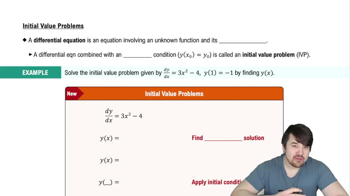 05:03
05:03Show that the solution of the initial value problem
y' = x + y, y(x₀) = y₀
is
y = -1 -x + (1 + x₀ + y₀) exp(x-x₀).
Use Euler’s method with dx = 0.5 to estimate y(5) if y′ = y²/√x and y(1) = −1. What is the exact value of y(5)?
Solving Initial Value Problems
Solve the initial value problems in Exercises 15–20.
θ dy/dθ + y = sin θ, θ > 0, y(π/2) = 1
Solving Initial Value Problems
Solve the initial value problems in Exercises 15–20.
dy/dt + 2y = 3, y(0) = 1
Solve the Bernoulli equations in Exercises 29–32.
y' - y = xy²
What integral equation is equivalent to the initial value problem y' = f(x), y(x₀) = y₀?