Ch. 1 - Equations and Inequalities
Blitzer - College Algebra 8th Edition
Blitzer8th EditionCollege AlgebraISBN: 9780136970514Not the one you use?Change textbook
Chapter 2, Problem 5a

Solve and check each linear equation. 3(x - 1) = 21

Verified step by step guidance
1
Distribute the 3 on the left-hand side of the equation to eliminate the parentheses. This means multiplying 3 by each term inside the parentheses: 3(x - 1) = 3x - 3. The equation becomes 3x - 3 = 21.
Add 3 to both sides of the equation to isolate the term with the variable on one side. This gives: 3x - 3 + 3 = 21 + 3, simplifying to 3x = 24.
Divide both sides of the equation by 3 to solve for x. This gives: x = \(\frac{24}{3}\).
Simplify the fraction \(\frac{24}{3}\) to find the value of x. This step completes the solution for x.
Check your solution by substituting the value of x back into the original equation 3(x - 1) = 21. Verify that both sides of the equation are equal.

Verified video answer for a similar problem:

This video solution was recommended by our tutors as helpful for the problem above.
Video duration:
2m
Was this helpful?

Key Concepts

Here are the essential concepts you must grasp in order to answer the question correctly.

Linear Equations

A linear equation is an algebraic expression that represents a straight line when graphed. It typically takes the form ax + b = c, where a, b, and c are constants, and x is the variable. Solving a linear equation involves isolating the variable to find its value, which satisfies the equation.
Recommended video:
06:00
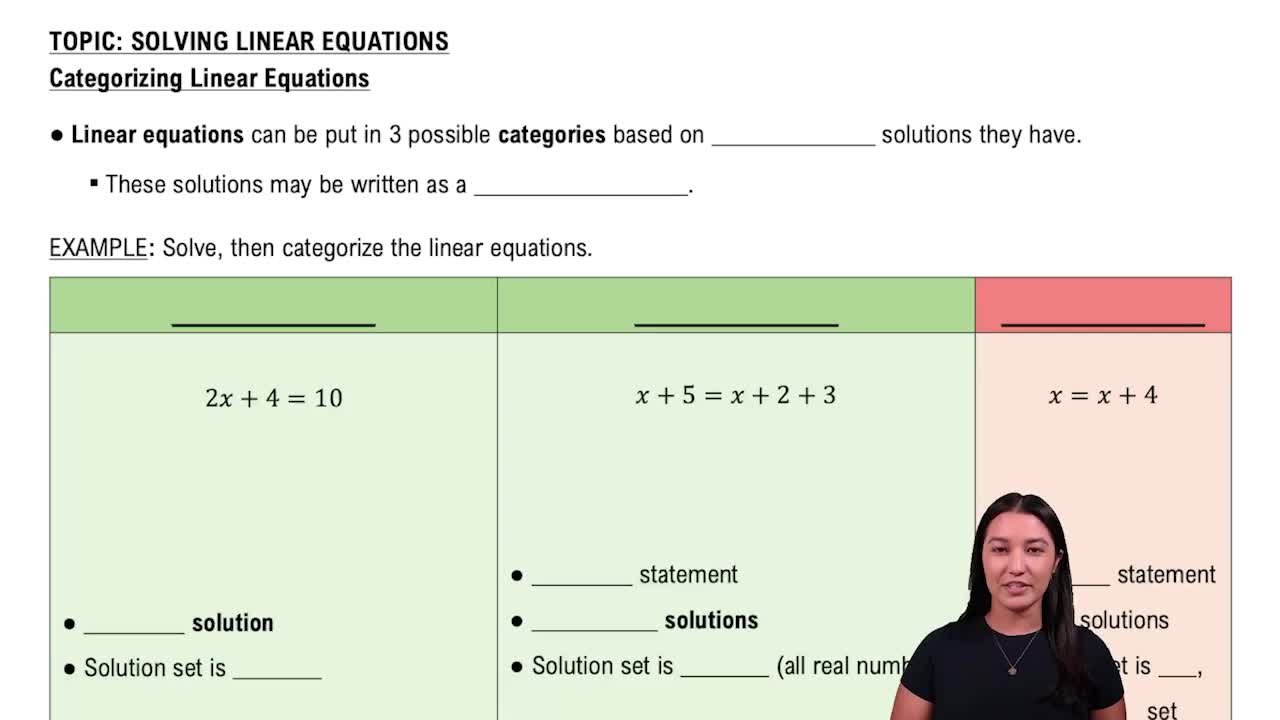
Categorizing Linear Equations

Distributive Property

The distributive property states that a(b + c) = ab + ac. This property is essential for simplifying expressions where a term is multiplied by a sum or difference. In the context of the given equation, applying the distributive property allows us to eliminate parentheses and simplify the equation for easier solving.
Recommended video:
Guided course
04:15
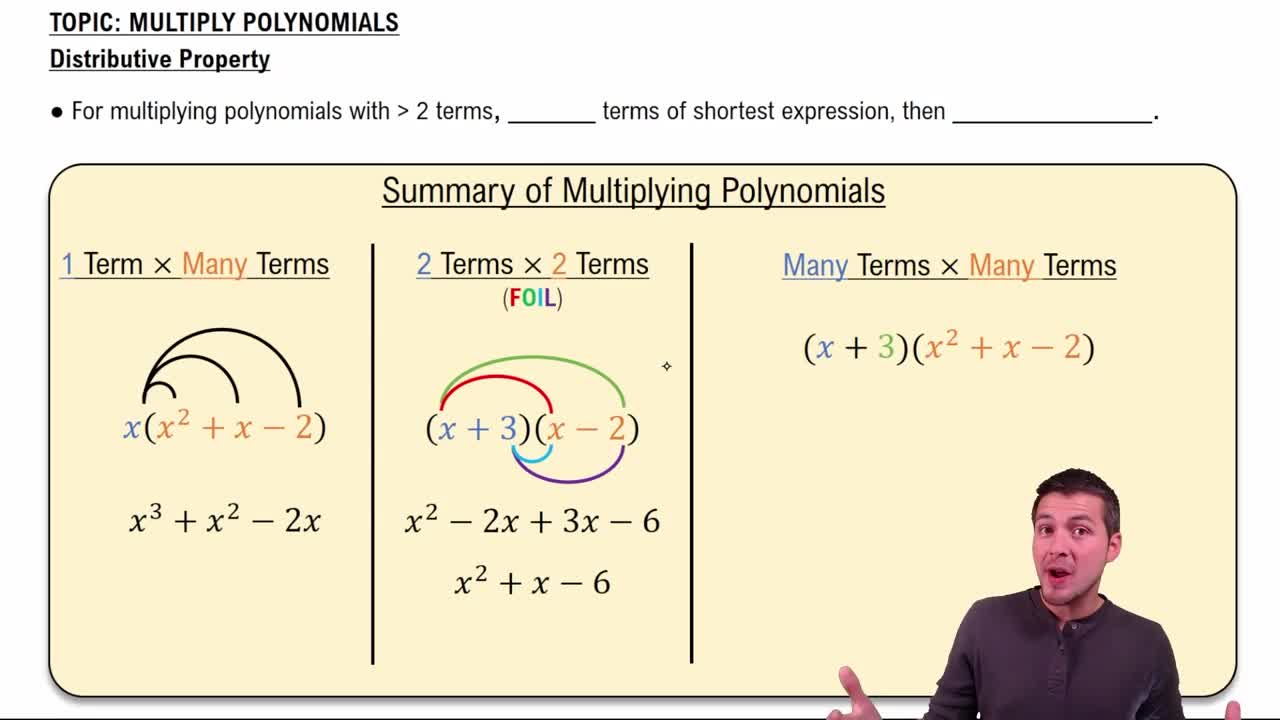
Multiply Polynomials Using the Distributive Property

Checking Solutions

Checking solutions involves substituting the found value of the variable back into the original equation to verify its correctness. This step ensures that the solution satisfies the equation, confirming that no errors were made during the solving process. It is a crucial part of solving linear equations to ensure accuracy.
Recommended video:
05:21
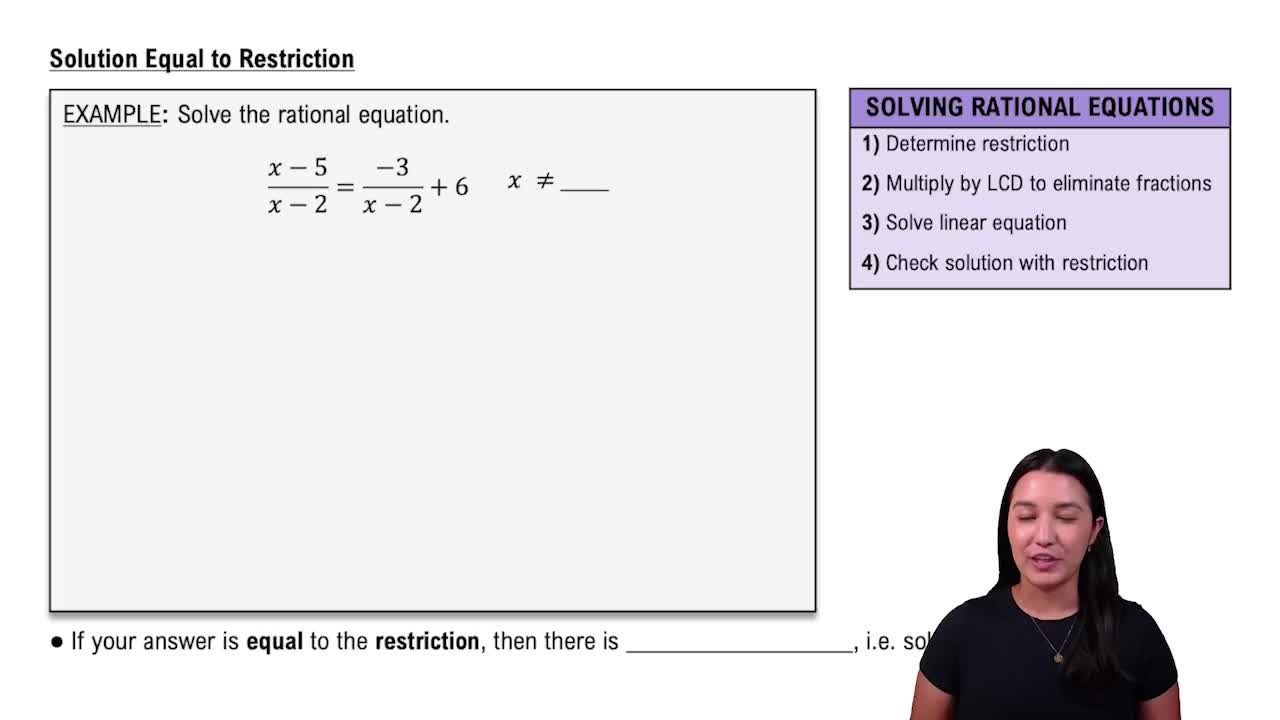
Restrictions on Rational Equations