Ch. 1 - Equations and Inequalities
Lial - College Algebra 13th Edition
Lial13th EditionCollege AlgebraISBN: 9780136881063Not the one you use?Change textbook
Chapter 2, Problem 15

Solve each equation. 56x2x+43=53\(\frac{5}{6}\)x - 2x + \(\frac{4}{3}\) = \(\frac{5}{3}\)

Verified step by step guidance
1
Start by rewriting the equation clearly: \(\frac{5}{6}x - 2x + \frac{4}{3} = \frac{5}{3}\).
Combine the like terms involving \(x\) on the left side. To do this, express \(-2x\) as a fraction with denominator 6: \(-2x = -\frac{12}{6}x\). Then combine \(\frac{5}{6}x - \frac{12}{6}x\).
Simplify the combined \(x\) terms to get a single fraction coefficient times \(x\). The equation now looks like \(\left(\frac{5}{6} - \frac{12}{6}\right)x + \frac{4}{3} = \frac{5}{3}\).
Isolate the \(x\) term by subtracting \(\frac{4}{3}\) from both sides: \(\left(\frac{5}{6} - \frac{12}{6}\right)x = \frac{5}{3} - \frac{4}{3}\).
Simplify the right side and then solve for \(x\) by dividing both sides by the coefficient of \(x\). This will give you the solution for \(x\).

Verified video answer for a similar problem:

This video solution was recommended by our tutors as helpful for the problem above.
Video duration:
3m
Was this helpful?

Key Concepts

Here are the essential concepts you must grasp in order to answer the question correctly.

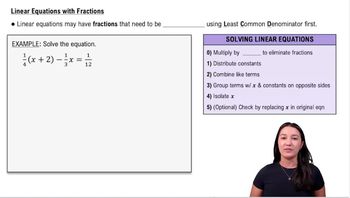
Solving Linear Equations

Solving linear equations involves finding the value of the variable that makes the equation true. This typically requires isolating the variable on one side by performing inverse operations such as addition, subtraction, multiplication, or division.
Recommended video:
04:02
Solving Linear Equations with Fractions

Combining Like Terms

Combining like terms means adding or subtracting terms that have the same variable raised to the same power. This simplifies the equation and makes it easier to solve by reducing the number of terms.
Recommended video:
5:22
Combinations

Working with Fractions in Equations

When solving equations with fractions, it is important to find a common denominator or multiply through by the least common denominator to eliminate fractions. This simplifies calculations and helps isolate the variable more efficiently.
Recommended video:
04:02
Solving Linear Equations with Fractions
Related Practice
Textbook Question

Determine the values of the variable that cannot possibly be solutions of each equation. Do not solve. 1/(4x) - 2/x = 3

530
views
Textbook Question

Use the following facts. If x represents an integer, then x+1 represents the next consecutive integer. If x represents an even integer, then x+2 represents the next consecutive even integer. If x represents an odd integer, then x+2 represents the next consecutive odd integer. The sum of the squares of two consecutive odd integers is 202. Find the integers.

865
views
Textbook Question

Solve each problem. See Example 1. The perimeter of a triangular plot of land is 2400 ft.The longest side is 200 ft less than twice the shortest. The middle side is 200 ft less than the longest side. Find the lengths of the three sides of the triangular plot.

707
views
Textbook Question

Solve each problem. (Modeling) Lead Intake As directed by the 'Safe Drinking Water Act' of December 1974, the EPA proposed a maximum lead level in public drinking water of 0.05 mg per liter. This standard assumed an individual consumption of two liters of water per day. If EPA guidelines are followed, write an equation that models the maximum amount of lead A ingested in x years. Assume that there are 365.25 days in a year.

628
views
Textbook Question

Use the following facts. If x represents an integer, then x+1 represents the next consecutive integer. If x represents an even integer, then x+2 represents the next consecutive even integer. If x represents an odd integer, then x+2 represents the next consecutive odd integer. The sum of the squares of two consecutive even integers is 52. Find the integers.

976
views
Textbook Question

Solve each equation. | 5/ (x-3) | = 10

562
views