Ch. 3 - Polynomial and Rational Functions
Lial - College Algebra 13th Edition
Lial13th EditionCollege AlgebraISBN: 9780136881063Not the one you use?Change textbook
Chapter 4, Problem 75b

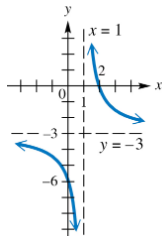
Solve each problem. Find a rational function ƒ having the graph shown.
Graph of a rational function with vertical asymptote at x=1 and horizontal asymptote at y=-3.

Verified step by step guidance
1
Identify the vertical asymptote from the graph. The vertical asymptote is the vertical dashed line where the function is undefined. Here, it is at \(x = 5\), so the denominator of the rational function will have a factor of \((x - 5)\).
Identify the horizontal asymptote from the graph. The horizontal asymptote is the horizontal dashed line that the graph approaches as \(x\) goes to infinity or negative infinity. Here, it is at \(y = -5\), so the rational function will have a horizontal asymptote at \(y = -5\).
Since the horizontal asymptote is \(y = -5\), the rational function can be expressed in the form \(f(x) = \frac{a}{x - 5} - 5\), where \(a\) is a constant to be determined.
Use the given points on the graph to find the value of \(a\). Substitute one of the points, for example \((4, 0)\), into the function: \(0 = \frac{a}{4 - 5} - 5\). Solve this equation for \(a\).
Verify the value of \(a\) by substituting the other given point \((0, -4)\) into the function \(f(x) = \frac{a}{x - 5} - 5\) and check if the equation holds true. This confirms the correct rational function.

Verified video answer for a similar problem:

This video solution was recommended by our tutors as helpful for the problem above.
Video duration:
4m
Was this helpful?

Key Concepts

Here are the essential concepts you must grasp in order to answer the question correctly.

Rational Functions and Their Graphs

A rational function is the ratio of two polynomials. Its graph can have vertical asymptotes where the denominator is zero and horizontal asymptotes that describe end behavior. Understanding how to interpret these features helps in identifying or constructing the function from its graph.
Recommended video:
8:19
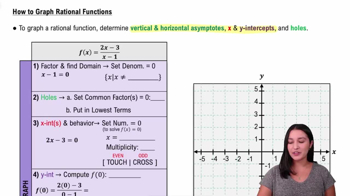
How to Graph Rational Functions

Vertical and Horizontal Asymptotes

Vertical asymptotes occur at values of x that make the denominator zero, indicating the function approaches infinity or negative infinity. Horizontal asymptotes describe the behavior of the function as x approaches infinity or negative infinity, often found by comparing degrees of numerator and denominator.
Recommended video:
4:48
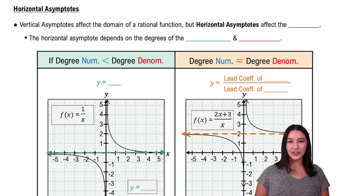
Determining Horizontal Asymptotes

Using Points on the Graph to Determine Function Parameters

Known points on the graph, such as intercepts, help determine the constants in the rational function. Substituting these points into the function allows solving for unknown coefficients, ensuring the function matches the given graph exactly.
Recommended video:
5:31
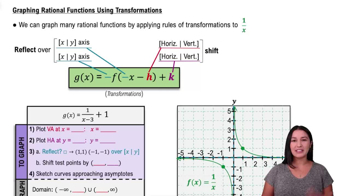
Graphing Rational Functions Using Transformations