Ch. P - Fundamental Concepts of Algebra
Blitzer - College Algebra 8th Edition
Blitzer8th EditionCollege AlgebraISBN: 9780136970514Not the one you use?Change textbook
Chapter 1, Problem 92

Factor completely, or state that the polynomial is prime. 64-x^2

Verified step by step guidance
1
Recognize that the given polynomial, 64 - x^2, is a difference of squares. The general formula for factoring a difference of squares is a^2 - b^2 = (a - b)(a + b).
Identify the terms in the polynomial that correspond to a^2 and b^2. Here, 64 is a perfect square (8^2), and x^2 is also a perfect square.
Rewrite the polynomial in the form of a^2 - b^2. In this case, it becomes (8)^2 - (x)^2.
Apply the difference of squares formula: (a - b)(a + b). Substitute a = 8 and b = x into the formula to get (8 - x)(8 + x).
Verify that the factorization is correct by expanding (8 - x)(8 + x) to ensure it simplifies back to 64 - x^2.

Verified video answer for a similar problem:

This video solution was recommended by our tutors as helpful for the problem above.
Video duration:
2m
Was this helpful?

Key Concepts

Here are the essential concepts you must grasp in order to answer the question correctly.

Factoring Polynomials

Factoring polynomials involves expressing a polynomial as a product of its simpler components, or factors. This process is essential for simplifying expressions and solving equations. Common techniques include identifying common factors, using special products, and applying methods like grouping or the quadratic formula when applicable.
Recommended video:
Guided course
07:30
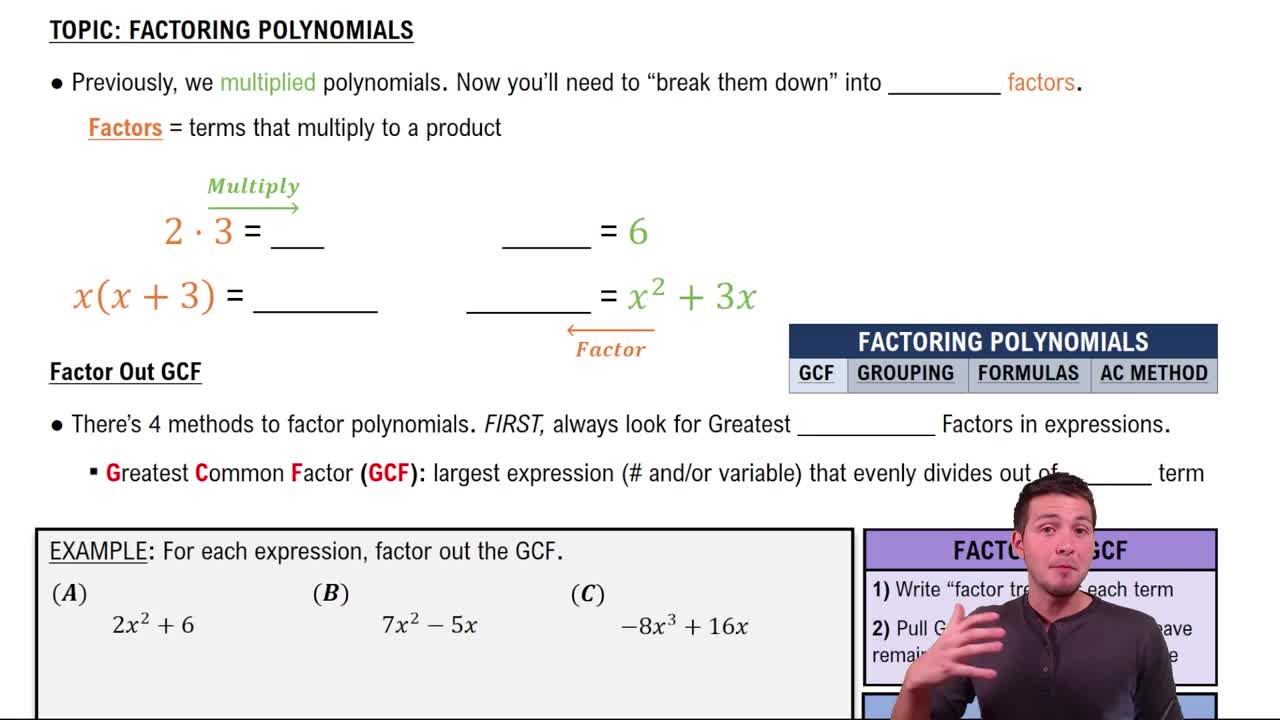
Introduction to Factoring Polynomials

Difference of Squares

The difference of squares is a specific factoring pattern that applies to expressions in the form of a^2 - b^2. It can be factored into (a - b)(a + b). Recognizing this pattern is crucial for quickly factoring polynomials like 64 - x^2, where 64 is 8^2 and x^2 is x^2, allowing for efficient simplification.
Recommended video:
06:24
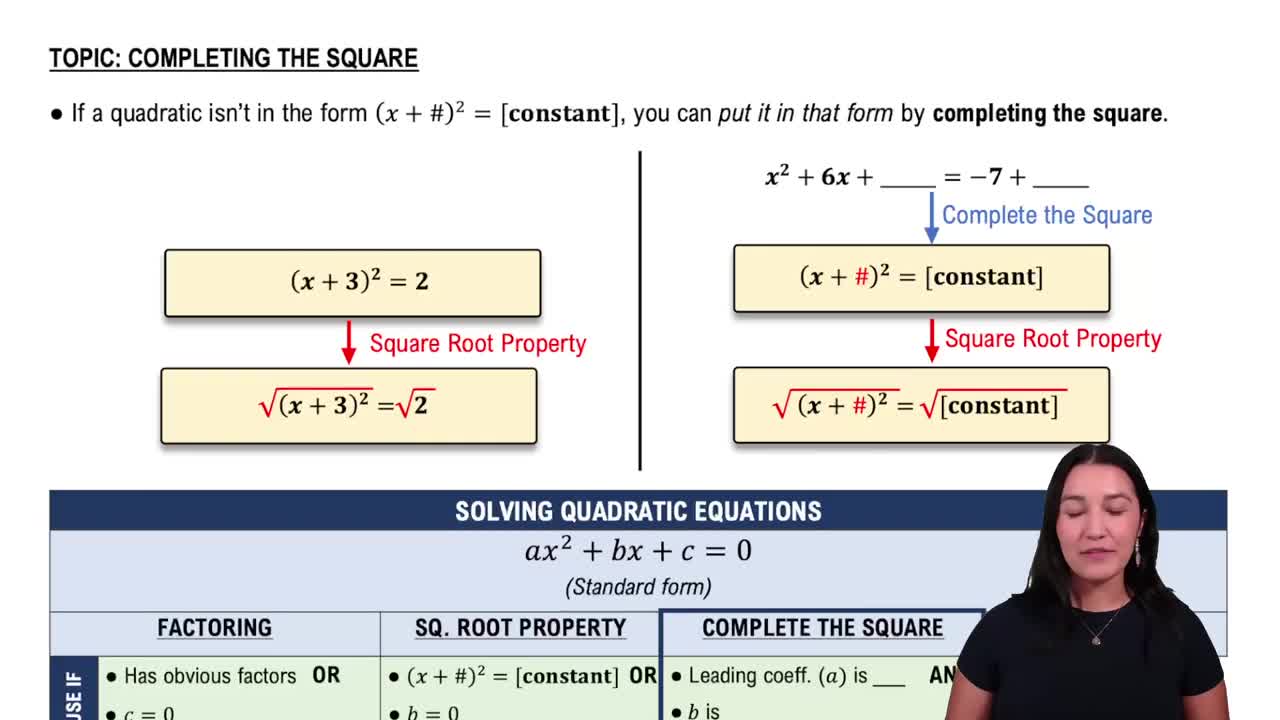
Solving Quadratic Equations by Completing the Square

Prime Polynomials

A polynomial is considered prime if it cannot be factored into the product of two non-constant polynomials with real coefficients. Understanding the criteria for prime polynomials is important for determining whether a polynomial can be simplified further or if it stands alone as an irreducible expression.
Recommended video:
Guided course
07:30
Introduction to Factoring Polynomials