Ch. 4 - Inverse, Exponential, and Logarithmic Functions
Lial - College Algebra 13th Edition
Lial13th EditionCollege AlgebraISBN: 9780136881063Not the one you use?Change textbook
Chapter 5, Problem 59

Graph each function. Give the domain and range. ƒ(x) = (log2 x) + 3

Verified step by step guidance
1
Identify the base function: The given function is \( f(x) = \log_2 x + 3 \). The base function here is \( \log_2 x \), which is a logarithmic function with base 2.
Determine the domain of the base function: Since \( \log_2 x \) is defined only for \( x > 0 \), the domain of \( f(x) \) is also \( x > 0 \). So, the domain is \( (0, \infty) \).
Analyze the vertical shift: The \( +3 \) outside the logarithm shifts the entire graph of \( \log_2 x \) upward by 3 units. This affects the range but not the domain.
Determine the range: The range of \( \log_2 x \) is all real numbers \( (-\infty, \infty) \). Adding 3 shifts the range up, but since the logarithm can take any real value, the range remains all real numbers \( (-\infty, \infty) \).
Sketch the graph: Start by plotting the basic \( \log_2 x \) curve, which passes through \( (1,0) \) because \( \log_2 1 = 0 \). Then shift every point up by 3 units to get the graph of \( f(x) = \log_2 x + 3 \).

Verified video answer for a similar problem:

This video solution was recommended by our tutors as helpful for the problem above.
Video duration:
3m
Was this helpful?

Key Concepts

Here are the essential concepts you must grasp in order to answer the question correctly.

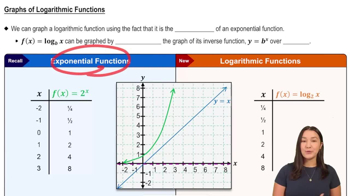
Logarithmic Functions

A logarithmic function is the inverse of an exponential function and is written as f(x) = log_b(x), where b is the base. It is defined only for positive x-values, and its graph passes through (1,0) because log_b(1) = 0. Understanding the shape and properties of logarithmic functions is essential for graphing.
Recommended video:
5:26
Graphs of Logarithmic Functions

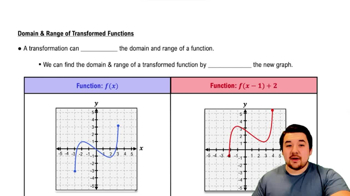
Domain and Range of Logarithmic Functions

The domain of a logarithmic function f(x) = log_b(x) consists of all positive real numbers (x > 0) because logarithms of zero or negative numbers are undefined. The range is all real numbers since the output can be any real value. Shifts and transformations affect these sets accordingly.
Recommended video:
4:22
Domain & Range of Transformed Functions

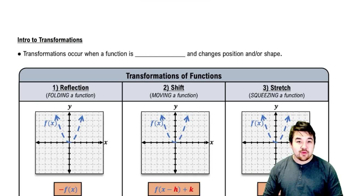
Vertical and Horizontal Transformations

Adding a constant to a function, such as f(x) = log_2(x) + 3, shifts the graph vertically. This transformation moves every point on the graph up by 3 units, affecting the range but not the domain. Recognizing these shifts helps in accurately graphing and determining the new range.
Recommended video:
5:25
Intro to Transformations