Complete the table of fraction, decimal and percent equivalents. Fraction in lowest terms(or Whole Number) ? Decimal ? Percent 20%
Table of contents
- 0. Review of Algebra4h 18m
- 1. Equations & Inequalities3h 18m
- 2. Graphs of Equations1h 43m
- 3. Functions2h 17m
- 4. Polynomial Functions1h 44m
- 5. Rational Functions1h 23m
- 6. Exponential & Logarithmic Functions2h 28m
- 7. Systems of Equations & Matrices4h 5m
- 8. Conic Sections2h 23m
- 9. Sequences, Series, & Induction1h 22m
- 10. Combinatorics & Probability1h 45m
0. Review of Algebra
Exponents
Problem 139
Textbook Question
Use the distributive property to calculate each value mentally. 12385⋅121−2385⋅121
Verified step by step guidance1
First, convert the mixed numbers into improper fractions for easier multiplication. For example, convert \$123 \frac{5}{8}\( and \)1 \frac{1}{2}$ into improper fractions.
Express the problem as \(\left(123 \frac{5}{8}\right) \times \left(1 \frac{1}{2}\right) - \left(23 \frac{5}{8}\right) \times \left(1 \frac{1}{2}\right)\) using the improper fractions.
Notice that both terms share a common factor of \$1 \frac{1}{2}\(, so apply the distributive property: factor out \)1 \frac{1}{2}$ from both terms.
Rewrite the expression as \(\left(123 \frac{5}{8} - 23 \frac{5}{8}\right) \times 1 \frac{1}{2}\), simplifying inside the parentheses first.
Finally, subtract the two mixed numbers inside the parentheses and then multiply the result by \$1 \frac{1}{2}$ to find the answer.
Verified video answer for a similar problem:This video solution was recommended by our tutors as helpful for the problem above
Video duration:
1mPlay a video:
Was this helpful?
Key Concepts
Here are the essential concepts you must grasp in order to answer the question correctly.
Distributive Property
The distributive property states that multiplying a sum by a number is the same as multiplying each addend by the number and then adding the products. It is expressed as a(b + c) = ab + ac. This property helps simplify expressions and perform mental calculations efficiently.
Recommended video:
Guided course
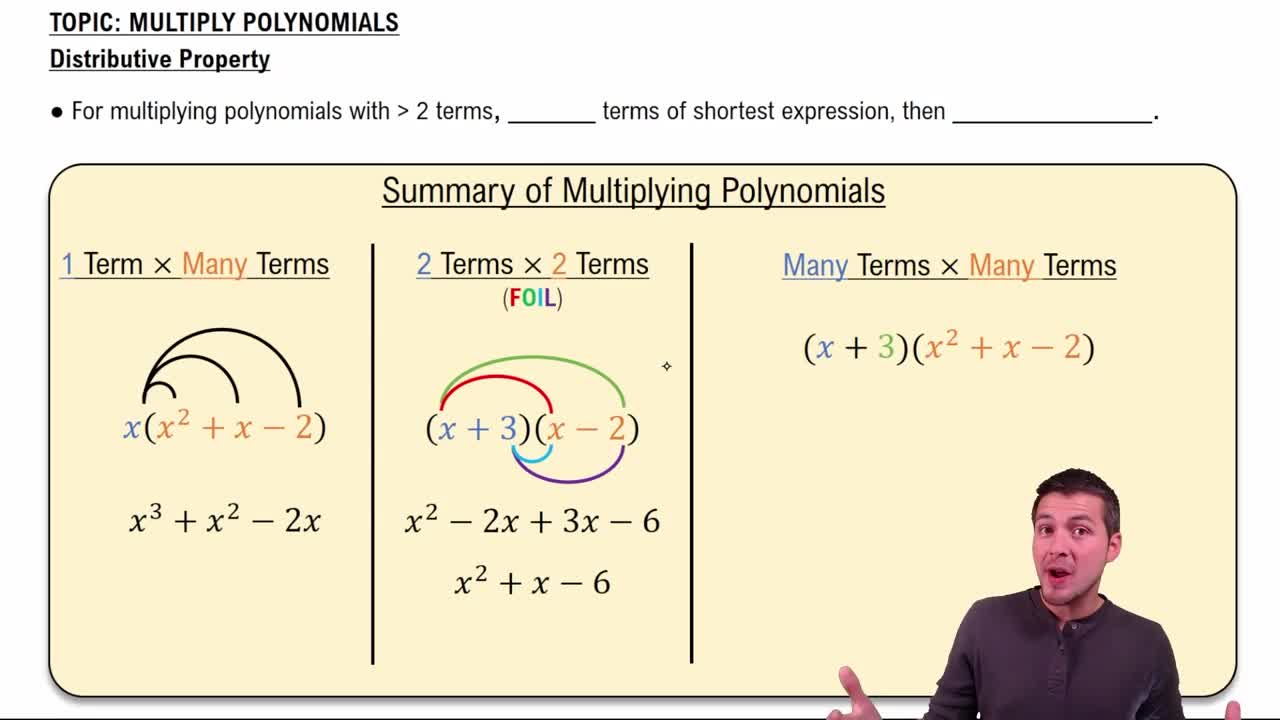
Multiply Polynomials Using the Distributive Property
Mixed Numbers and Improper Fractions
Mixed numbers combine whole numbers and fractions, such as 1 1/2. Converting mixed numbers to improper fractions (e.g., 1 1/2 = 3/2) simplifies multiplication and subtraction. Understanding this conversion is essential for accurate calculations.
Recommended video:
Dividing Complex Numbers
Mental Math Strategies
Mental math involves performing calculations in your head without paper. Using properties like distributive property and converting mixed numbers helps break down complex problems into simpler parts, enabling quicker and more accurate mental computation.
Recommended video:
Decomposition of Functions
Watch next
Master Introduction to Exponent Rules with a bite sized video explanation from Patrick
Start learningRelated Videos
Related Practice
Textbook Question
1345
views