Ch. 4 - Inverse, Exponential, and Logarithmic Functions
Lial - College Algebra 13th Edition
Lial13th EditionCollege AlgebraISBN: 9780136881063Not the one you use?Change textbook
Chapter 5, Problem 38

Solve each equation. log1/3 (x+6) = -2

Verified step by step guidance
1
Recall the definition of a logarithm: if \(\log_{a}(b) = c\), then it is equivalent to the exponential form \(a^{c} = b\).
Rewrite the given equation \(\log_{\frac{1}{3}}(x+6) = -2\) in exponential form using the base \(\frac{1}{3}\) and the exponent \(-2\): \(\left(\frac{1}{3}\right)^{-2} = x + 6\).
Simplify the expression \(\left(\frac{1}{3}\right)^{-2}\) by applying the negative exponent rule: \(\left(\frac{1}{3}\right)^{-2} = 3^{2}\).
Calculate \$3^{2}\( to get the value on the right side of the equation, then set it equal to \)x + 6$.
Solve for \(x\) by subtracting 6 from both sides: \(x = 3^{2} - 6\).

Verified video answer for a similar problem:

This video solution was recommended by our tutors as helpful for the problem above.
Video duration:
4m
Was this helpful?

Key Concepts

Here are the essential concepts you must grasp in order to answer the question correctly.

Logarithmic Functions and Their Properties

A logarithmic function is the inverse of an exponential function. The expression log_b(a) = c means that b raised to the power c equals a. Understanding this relationship allows you to rewrite logarithmic equations in exponential form to solve for the variable.
Recommended video:
5:26
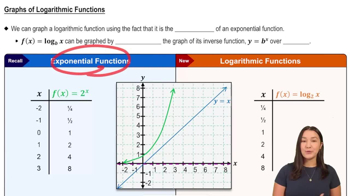
Graphs of Logarithmic Functions

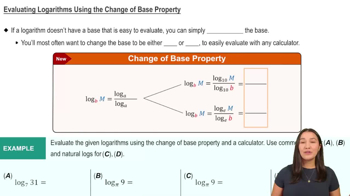
Change of Base and Negative Logarithms

Logarithms with bases between 0 and 1, such as 1/3, produce negative values for inputs greater than 1. Recognizing how the base affects the sign and behavior of the logarithm is essential when solving equations involving fractional bases.
Recommended video:
5:36
Change of Base Property

Solving Logarithmic Equations by Exponentiation

To solve equations like log_b(x + 6) = -2, rewrite the equation in exponential form: x + 6 = b^{-2}. Then calculate the power and isolate x. This method transforms the logarithmic equation into a simpler algebraic equation.
Recommended video:
5:02
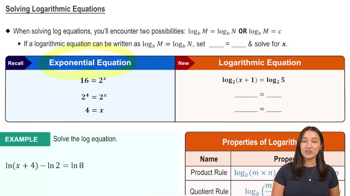
Solving Logarithmic Equations