Ch. 4 - Inverse, Exponential, and Logarithmic Functions
Lial - College Algebra 13th Edition
Lial13th EditionCollege AlgebraISBN: 9780136881063Not the one you use?Change textbook
Chapter 5, Problem 37

Graph each function. See Example 2. ƒ(x) = 2|x|

Verified step by step guidance
1
Understand the function given: \(f(x) = 2^{|x|}\). This means the output is 2 raised to the power of the absolute value of \(x\).
Recall that the absolute value function \(|x|\) makes all \(x\) values non-negative, so for negative \(x\), \(|x| = -x\), and for non-negative \(x\), \(|x| = x\).
Rewrite the function as a piecewise function to understand its behavior on both sides of the y-axis: \(f(x) = \begin{cases} 2^x & \text{if } x \geq 0 \\ 2^{-x} & \text{if } x < 0 \end{cases}\)
Graph the right side (\(x \geq 0\)) using the exponential function \$2^x\(, which increases as \)x$ increases.
Graph the left side (\(x < 0\)) using \$2^{-x}\(, which is the reflection of \)2^x$ across the y-axis, ensuring the graph is symmetric about the y-axis.

Verified video answer for a similar problem:

This video solution was recommended by our tutors as helpful for the problem above.
Video duration:
4m
Was this helpful?

Key Concepts

Here are the essential concepts you must grasp in order to answer the question correctly.

Absolute Value Function

The absolute value function, denoted |x|, outputs the non-negative value of x, making all inputs positive or zero. It creates a V-shaped graph symmetric about the y-axis, affecting how the function behaves for negative and positive inputs.
Recommended video:
4:56
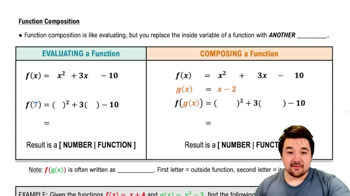
Function Composition

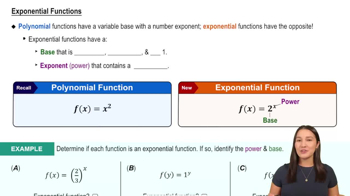
Exponential Functions

Exponential functions have the form f(x) = a^x, where the base a is positive and not equal to 1. They exhibit rapid growth or decay, and their graphs pass through (0,1), reflecting the property that any number to the zero power equals one.
Recommended video:
6:13
Exponential Functions

Graphing Composite Functions

Graphing composite functions like f(x) = 2^{|x|} involves understanding how the inner function (absolute value) transforms the input before applying the outer function (exponential). This results in a graph symmetric about the y-axis, combining properties of both functions.
Recommended video:
4:56
Function Composition