Ch. 4 - Inverse, Exponential, and Logarithmic Functions
Lial - College Algebra 13th Edition
Lial13th EditionCollege AlgebraISBN: 9780136881063Not the one you use?Change textbook
Chapter 5, Problem 79

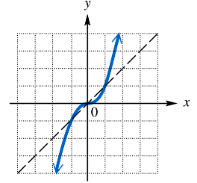
Graph the inverse of each one-to-one function.

Verified step by step guidance
1
Step 1: Understand that the inverse of a function reflects the graph of the original function across the line \(y = x\). This means every point \((a, b)\) on the original function will correspond to a point \((b, a)\) on the inverse function.
Step 2: Identify key points on the original graph. For example, note points where the curve crosses grid lines or has notable coordinates, such as the origin \((0,0)\) and other points where the function value is clear.
Step 3: For each key point \((x, y)\) on the original graph, plot the point \((y, x)\) on the coordinate plane. This will give you points on the inverse function.
Step 4: Connect these new points smoothly, maintaining the shape but reflected over the line \(y = x\). The inverse graph should be a mirror image of the original graph with respect to this line.
Step 5: Optionally, draw the line \(y = x\) as a reference to verify that the original function and its inverse are symmetric about this line.

Verified video answer for a similar problem:

This video solution was recommended by our tutors as helpful for the problem above.
Video duration:
1m
Was this helpful?

Key Concepts

Here are the essential concepts you must grasp in order to answer the question correctly.

One-to-One Function

A one-to-one function is a function where each input corresponds to a unique output, and no two different inputs share the same output. This property ensures the function has an inverse because it can be reversed without ambiguity.
Recommended video:
4:07
Decomposition of Functions

Inverse Function

The inverse of a function reverses the roles of inputs and outputs, swapping x and y values. Graphically, the inverse function is the reflection of the original function across the line y = x, meaning every point (a, b) on the function corresponds to (b, a) on its inverse.
Recommended video:
4:30
Graphing Logarithmic Functions

Graphing and Reflection Across y = x

To graph the inverse of a function, reflect the original graph across the line y = x. This means that the x-coordinates and y-coordinates of all points on the original graph are interchanged, producing the graph of the inverse function.
Recommended video:
4:25
Graphs of Shifted & Reflected Functions