Ch. R - Review of Basic Concepts
Lial - College Algebra 13th Edition
Lial13th EditionCollege AlgebraISBN: 9780136881063Not the one you use?Change textbook
Chapter 1, Problem 82

Evaluate each expression. -35

Verified step by step guidance
1
Recognize that the expression is \(-3^5\), which means the exponent applies only to the 3, not the negative sign, because there are no parentheses around \(-3\).
Rewrite the expression as \(-(3^5)\) to clarify the order of operations: the exponent is evaluated first, then the negative sign is applied.
Calculate \(3^5\), which means multiplying 3 by itself 5 times: \(3 \times 3 \times 3 \times 3 \times 3\).
After finding the value of \(3^5\), apply the negative sign to that result to get the final value of the expression.
Write the final expression as \(- (3^5)\) and substitute the calculated value of \(3^5\) to complete the evaluation.

Verified video answer for a similar problem:

This video solution was recommended by our tutors as helpful for the problem above.
Video duration:
1m
Was this helpful?

Key Concepts

Here are the essential concepts you must grasp in order to answer the question correctly.

Order of Operations

The order of operations dictates the sequence in which parts of a mathematical expression are evaluated. Exponents are calculated before multiplication or negation unless parentheses indicate otherwise. This ensures consistent and correct evaluation of expressions.
Recommended video:
Guided course
8:38
Performing Row Operations on Matrices

Exponents and Powers

An exponent indicates how many times a base number is multiplied by itself. For example, 3^5 means 3 × 3 × 3 × 3 × 3. Understanding how to compute powers is essential for evaluating expressions involving exponents.
Recommended video:
04:10
Powers of i

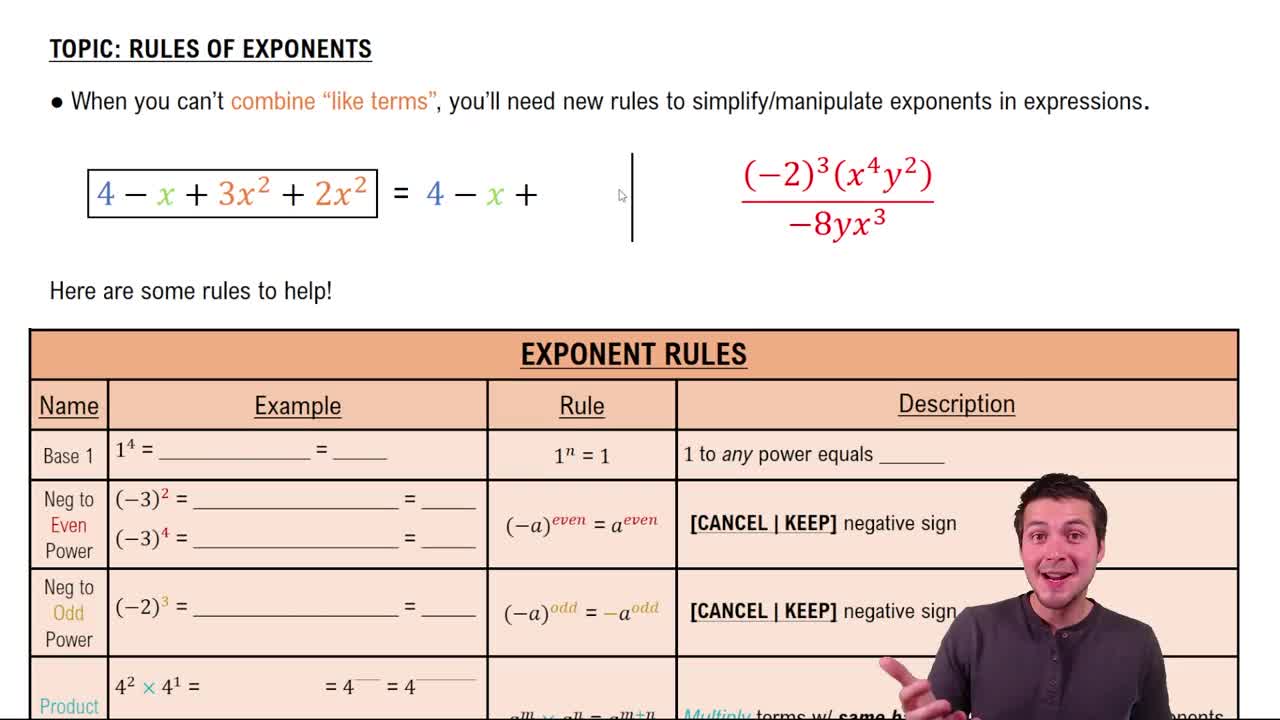
Negative Signs and Exponents

A negative sign in front of a base without parentheses is treated as multiplication by -1 after exponentiation. For example, -3^5 means -(3^5), not (-3)^5. Parentheses change this order, affecting the final result.
Recommended video:
Guided course
7:39
Introduction to Exponent Rules