Determine whether each transition in the hydrogen atom corresponds to absorption or emission of energy. a. n = 3 → n = 1 b. n = 2 → n = 4 c. n = 4 → n = 3
Ch.7 - Quantum-Mechanical Model of the Atom
Chapter 7, Problem 65
An electron in a hydrogen atom is excited with electrical energy to an excited state with n = 2. The atom then emits a photon. What is the value of n for the electron after the emission?
Verified step by step guidance1
Identify the initial excited state of the electron, which is given as n = 2.
Understand that when an electron emits a photon, it transitions to a lower energy level.
Recall that the lowest energy level for a hydrogen atom is n = 1, which is the ground state.
Since the electron is initially at n = 2 and emits a photon, it will transition to the next lower energy level.
Conclude that the value of n for the electron after the emission is n = 1.
Key Concepts
Here are the essential concepts you must grasp in order to answer the question correctly.
Quantum States and Energy Levels
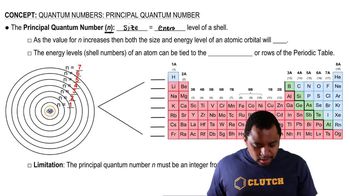
In quantum mechanics, electrons in an atom occupy discrete energy levels, denoted by quantum numbers (n). The principal quantum number n indicates the electron's energy level, with lower values corresponding to closer proximity to the nucleus. For hydrogen, these levels are quantized, meaning an electron can only exist in specific states.
Recommended video:
Guided course
Principal Quantum Number
Photon Emission
When an electron transitions from a higher energy level to a lower one, it emits energy in the form of a photon. The energy of the emitted photon corresponds to the difference in energy between the two levels. This process is fundamental in understanding how atoms interact with light and is key to phenomena such as spectral lines.
Excited State and Ground State
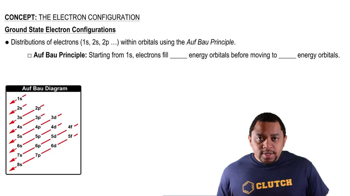
An excited state refers to an electron being in a higher energy level (n > 1) compared to its ground state, where n = 1. After emitting a photon, the electron returns to a lower energy level, which could be the ground state or another excited state, depending on the energy released. In this case, the electron will return to n = 1 after the emission.
Recommended video:
Guided course
Ground State Electron Configurations
Related Practice
Textbook Question
3571
views
3
rank
Textbook Question
Which combinations of n and l represent real orbitals, and which do not exist? a. 1s b. 2p c. 4s d. 2d
2102
views
1
rank
Textbook Question
According to the quantum-mechanical model for the hydrogen atom, which electron transition produces light with the longer wavelength: 3p → 2s or 4p → 3p?
1091
views
2
comments
Textbook Question
Calculate the frequency of the light emitted when an electron in a hydrogen atom makes each transition: a. n = 4 → n = 3 b. n = 5 → n = 1 c. n = 5 → n = 4 d. n = 6 → n = 5
8404
views
1
rank
Textbook Question
Which set of quantum numbers cannot occur together to specify an orbital? a. n = 2, l = 1, ml = -1 b. n = 3, l = 2, ml = 0 c. n = 3, l = 3, ml = 2 d. n = 4, l = 3, ml = 0
5208
views
1
rank
Textbook Question
Sketch the 1s and 2p orbitals. How do the 2s and 3p orbitals differ from the 1s and 2p orbitals?
1729
views