Define each of the following terms: Complementary base pair
Verified step by step guidance
1
Understand that complementary base pairing refers to the specific pairing of nitrogenous bases in DNA and RNA, which is essential for the structure and function of nucleic acids.
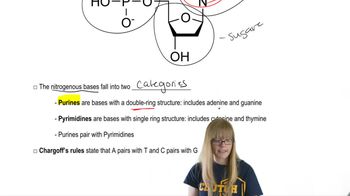
Recall that in DNA, adenine (A) pairs with thymine (T) through two hydrogen bonds, and cytosine (C) pairs with guanine (G) through three hydrogen bonds.
Note that in RNA, adenine (A) pairs with uracil (U) instead of thymine (T), while cytosine (C) still pairs with guanine (G).
Explain that complementary base pairing ensures accurate replication of DNA and proper transcription of RNA, maintaining genetic fidelity.
Summarize that complementary base pairs are a fundamental concept in molecular genetics, enabling the double-helix structure of DNA and the transfer of genetic information.
Verified video answer for a similar problem:
This video solution was recommended by our tutors as helpful for the problem above
Video duration:
38s
Play a video:
Was this helpful?
Key Concepts
Here are the essential concepts you must grasp in order to answer the question correctly.
Complementary Base Pairing
Complementary base pairing refers to the specific pairing of nitrogenous bases in DNA and RNA. In DNA, adenine (A) pairs with thymine (T), and cytosine (C) pairs with guanine (G). This pairing is crucial for the structure of the double helix and ensures accurate replication and transcription of genetic information.
DNA is structured as a double helix, consisting of two strands that run in opposite directions. The backbone of each strand is made of sugar and phosphate groups, while the rungs are formed by complementary base pairs. This structure is essential for the stability of genetic material and the processes of replication and gene expression.
Base pairing rules dictate how nucleotides pair in nucleic acids. In DNA, A pairs with T and C pairs with G, while in RNA, A pairs with U (uracil) instead of T. These rules are fundamental for maintaining the integrity of genetic information during processes like DNA replication and RNA transcription.