Give descriptions for the following terms: G bands
Verified step by step guidance
1
G bands, or Giemsa bands, are regions of chromosomes that are stained using a dye called Giemsa. This staining technique is used in cytogenetics to visualize the structure of chromosomes.
The Giemsa stain binds to regions of DNA that are rich in adenine (A) and thymine (T) base pairs, resulting in darkly stained bands. These regions are typically gene-poor and are referred to as heterochromatic regions.
In contrast, regions of the chromosome that are gene-rich and have a higher proportion of guanine (G) and cytosine (C) base pairs stain lightly and are referred to as euchromatic regions.
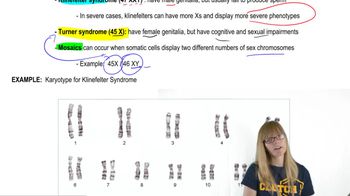
G banding is used to identify chromosomal abnormalities, such as deletions, duplications, or translocations, by comparing the banding patterns of chromosomes from an individual to a standard karyotype.
This technique is particularly useful in diagnosing genetic disorders and in studying chromosomal structure and function in both clinical and research settings.
Verified video answer for a similar problem:
This video solution was recommended by our tutors as helpful for the problem above
Video duration:
2m
Play a video:
Was this helpful?
Key Concepts
Here are the essential concepts you must grasp in order to answer the question correctly.
G Bands
G bands are specific patterns of light and dark bands observed on chromosomes when stained with Giemsa stain. These bands are used in karyotyping to identify and differentiate chromosomes based on their size and banding patterns, which are indicative of the chromosomal structure and genetic content.
Chromosomes are long, thread-like structures made of DNA and proteins that carry genetic information. Each chromosome consists of a centromere, which divides it into two arms, and telomeres at each end. The specific arrangement of genes and the presence of heterochromatin and euchromatin contribute to the distinct banding patterns seen in G bands.
Karyotyping is a laboratory technique used to visualize and analyze the number and structure of chromosomes in a cell. By arranging chromosomes in pairs and identifying their G band patterns, researchers can detect chromosomal abnormalities, such as aneuploidy or structural rearrangements, which are important in diagnosing genetic disorders.