Pearson+ LogoPearson+ Logo
Ch. 10 - Eukaryotic Chromosome Abnormalities and Molecular Organization
Sanders - Genetic Analysis: An Integrated Approach 3rd Edition
Sanders3rd EditionGenetic Analysis: An Integrated ApproachISBN: 9780135564172Not the one you use?Change textbook
Chapter 10, Problem 31a

For the following crosses, determine as accurately as possible the genotypes of each parent, the parent in whom nondisjunction occurs, and whether nondisjunction takes place in the first or second meiotic division. Both color blindness and hemophilia, a blood-clotting disorder, are X-linked recessive traits. In each case, assume the parents have normal karyotypes.
A man and a woman who each has the wild-type phenotype have a son with Klinefelter syndrome (XXY) who has hemophilia.

Verified step by step guidance
1
Step 1: Understand the genetic basis of the traits and syndrome. Color blindness and hemophilia are X-linked recessive traits, meaning they are carried on the X chromosome and require two copies of the recessive allele in females (XX) or one copy in males (XY) to express the phenotype. Klinefelter syndrome (XXY) results from nondisjunction, where an individual has an extra X chromosome.
Step 2: Analyze the phenotypes of the parents. Both the man and the woman have wild-type phenotypes, meaning they do not express hemophilia. This suggests that the woman may be a carrier of the hemophilia allele (X^H X^h), while the man has a normal X chromosome (X^H Y).
Step 3: Determine the genotype of the son. The son has Klinefelter syndrome (XXY) and hemophilia. This means he must have inherited two X chromosomes (one from each parent) and one Y chromosome from his father. The X chromosome carrying the hemophilia allele (X^h) must have come from the mother.
Step 4: Identify the parent in whom nondisjunction occurred. Since the son has two X chromosomes, nondisjunction must have occurred in the mother during meiosis. This resulted in an egg with two X chromosomes (X^H X^h) instead of one.
Step 5: Determine the stage of nondisjunction. If the two X chromosomes in the egg are different (X^H and X^h), nondisjunction occurred during meiosis I, when homologous chromosomes fail to separate. If the two X chromosomes are identical, nondisjunction occurred during meiosis II, when sister chromatids fail to separate.

Verified video answer for a similar problem:

This video solution was recommended by our tutors as helpful for the problem above.
Video duration:
5m
Was this helpful?

Key Concepts

Here are the essential concepts you must grasp in order to answer the question correctly.

X-linked Inheritance

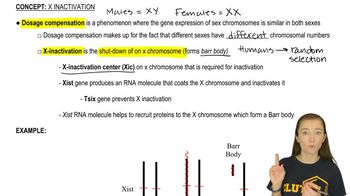
X-linked inheritance refers to the pattern of inheritance for genes located on the X chromosome. In this case, traits such as color blindness and hemophilia are X-linked recessive, meaning that males (XY) are more likely to express these traits since they have only one X chromosome. Females (XX) can be carriers if they have one affected X chromosome but typically do not express the trait unless both X chromosomes are affected.
Recommended video:
Guided course
09:30
X-Inactivation

Nondisjunction

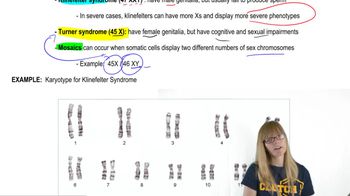
Nondisjunction is the failure of homologous chromosomes or sister chromatids to separate properly during cell division, leading to gametes with an abnormal number of chromosomes. This can occur during either the first or second meiotic division. In the context of Klinefelter syndrome (XXY), nondisjunction likely occurred during meiosis in one of the parents, resulting in the son having an extra X chromosome.
Recommended video:
Guided course
04:34
Allopolyploidy

Klinefelter Syndrome

Klinefelter syndrome is a genetic condition in males characterized by the presence of an extra X chromosome, resulting in a 47,XXY karyotype. This condition can lead to various physical and developmental features, including infertility and certain health issues. In the scenario presented, the son with Klinefelter syndrome also has hemophilia, indicating that the extra X chromosome may carry the recessive allele for this blood-clotting disorder.
Recommended video:
Guided course
10:35
Human Sex Chromosomes
Related Practice
Textbook Question

A eukaryote with a diploid number of 2n=6 carries the chromosomes shown below and labeled (a) to (f).

Carefully examine and redraw these chromosomes in any valid metaphase I alignment. Draw and label the metaphase plate, and label each chromosome with its assigned letter. 

2237
views
Textbook Question

A eukaryote with a diploid number of 2n=6 carries the chromosomes shown below and labeled (a) to (f).


Explain how you determined the correct alignment of homologous chromosomes on opposite sides of the metaphase plate. 

496
views
Textbook Question

Human chromosome 5 and the corresponding chromosomes from chimpanzee, gorilla, and orangutan are shown here. Describe any structural differences you see in the other primate chromosomes in relation to the human chromosome.

641
views
Textbook Question

For the following crosses, determine as accurately as possible the genotypes of each parent, the parent in whom nondisjunction occurs, and whether nondisjunction takes place in the first or second meiotic division. Both color blindness and hemophilia, a blood-clotting disorder, are X-linked recessive traits. In each case, assume the parents have normal karyotypes.

A man who is color blind and a woman who is wild type have a son with Jacob syndrome (XYY) who has hemophilia.

529
views
Textbook Question

For the following crosses, determine as accurately as possible the genotypes of each parent, the parent in whom nondisjunction occurs, and whether nondisjunction takes place in the first or second meiotic division. Both color blindness and hemophilia, a blood-clotting disorder, are X-linked recessive traits. In each case, assume the parents have normal karyotypes.

A color-blind man and a woman who is wild type have a daughter with Turner syndrome (XO) who has normal color vision and blood clotting.

526
views
Textbook Question

For the following crosses, determine as accurately as possible the genotypes of each parent, the parent in whom nondisjunction occurs, and whether nondisjunction takes place in the first or second meiotic division. Both color blindness and hemophilia, a blood-clotting disorder, are X-linked recessive traits. In each case, assume the parents have normal karyotypes.

A man who is color blind and has hemophilia and a woman who is wild type have a daughter with triple X syndrome (XXX) who has hemophilia and normal color vision.

529
views