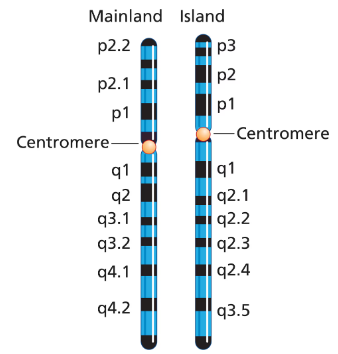
A small population of deer living on an isolated island is separated for many generations from a mainland deer population. The populations retain the same number of chromosomes but hybrids are infertile. One chromosome (shown here) has a different banding pattern in the island population than in the mainland population. Suppose that 40% of all meioses in mainland–island hybrids involve recombination somewhere in the chromosome region between q2.1 and p2. What proportion of the gametes of hybrid deer are viable? What is the cause of the decreased proportion of viable gametes in hybrids relative to the parental populations?
Verified step by step guidance
1
Understand the problem: The question involves hybrid infertility due to chromosomal differences between two populations of deer. The key is to analyze the recombination frequency and its impact on gamete viability.
Step 1: Recognize that the hybrid infertility is caused by structural differences in the chromosomes between the island and mainland populations. These differences can lead to improper pairing during meiosis, resulting in unbalanced gametes.
Step 2: Note that 40% of meioses involve recombination in the region between q2.1 and p2. Recombination in structurally different chromosomes can lead to duplications or deletions in the resulting gametes, making them non-viable.
Step 3: Calculate the proportion of viable gametes. If 40% of meioses involve recombination, then 60% of meioses do not involve recombination. Gametes from non-recombinant meioses are viable, while those from recombinant meioses are not.
Step 4: The decreased proportion of viable gametes in hybrids is due to the structural differences in the chromosomes. These differences disrupt proper alignment and segregation during meiosis, leading to unbalanced gametes in recombinant events.
Verified video answer for a similar problem:
This video solution was recommended by our tutors as helpful for the problem above
Video duration:
1m
Play a video:
Was this helpful?
Key Concepts
Here are the essential concepts you must grasp in order to answer the question correctly.
Meiosis and Gamete Formation
Meiosis is a specialized type of cell division that reduces the chromosome number by half, resulting in the formation of gametes (sperm and eggs). During meiosis, homologous chromosomes undergo recombination, where segments of DNA are exchanged, leading to genetic diversity. In the context of hybrids, understanding how meiosis operates is crucial, as it directly affects the viability of gametes produced by hybrid individuals.
Hybrid incompatibility occurs when two different species or populations interbreed, resulting in offspring that are often sterile or have reduced fitness. This can be due to genetic differences that disrupt normal development or reproductive processes. In the case of the deer populations, the infertility of hybrids suggests that genetic divergence has led to incompatibilities that affect gamete viability.
Chromosomal banding patterns are visual representations of chromosomes that highlight specific regions, allowing for the identification of structural differences between chromosomes from different populations. These differences can indicate genetic divergence and may contribute to reproductive barriers. In the scenario described, the distinct banding patterns between the island and mainland deer populations suggest evolutionary changes that could impact hybrid viability.