Pearson+ LogoPearson+ Logo
Ch. 13 - Regulation of Gene Expression in Eukaryotes
Sanders - Genetic Analysis: An Integrated Approach 3rd Edition
Sanders3rd EditionGenetic Analysis: An Integrated ApproachISBN: 9780135564172Not the one you use?Change textbook
Chapter 13, Problem 1d

Devoting a few sentences to each, describe the following structures or complexes and their effects on eukaryotic gene expression:
RISC

Verified step by step guidance
1
Understand that RISC stands for RNA-Induced Silencing Complex, which is a key player in the RNA interference (RNAi) pathway, a mechanism for regulating gene expression in eukaryotic cells.
Learn that RISC is formed when a small RNA molecule, such as a microRNA (miRNA) or small interfering RNA (siRNA), binds to the Argonaute protein, which is the core component of the complex.
Recognize that the small RNA within RISC serves as a guide by base-pairing with complementary sequences in target messenger RNA (mRNA) molecules.
Understand that once RISC binds to its target mRNA, it can either degrade the mRNA or inhibit its translation, depending on the degree of complementarity between the small RNA and the mRNA.
Conclude that the overall effect of RISC on eukaryotic gene expression is to reduce or silence the expression of specific genes, making it a critical tool for post-transcriptional gene regulation.

Verified video answer for a similar problem:

This video solution was recommended by our tutors as helpful for the problem above.
Video duration:
1m
Was this helpful?

Key Concepts

Here are the essential concepts you must grasp in order to answer the question correctly.

RNA-Induced Silencing Complex (RISC)

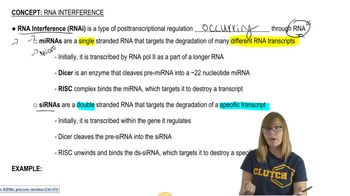
RISC is a multi-protein complex that plays a crucial role in RNA interference (RNAi), a biological process that regulates gene expression. It incorporates small RNA molecules, such as microRNAs (miRNAs) or small interfering RNAs (siRNAs), which guide the complex to complementary mRNA targets. Once bound, RISC can either degrade the mRNA or inhibit its translation, effectively silencing the gene associated with that mRNA.
Recommended video:

MicroRNAs (miRNAs)

MicroRNAs are short, non-coding RNA molecules that regulate gene expression by binding to complementary sequences in target mRNAs. They are processed from longer precursor molecules and play a significant role in post-transcriptional regulation. By influencing mRNA stability and translation, miRNAs can modulate various biological processes, including development, differentiation, and response to stress.
Recommended video:
Guided course
06:59
RNA Interference

Gene Silencing

Gene silencing refers to the process by which the expression of a gene is inhibited or completely turned off. This can occur through various mechanisms, including RNA interference, where RISC and small RNAs target specific mRNAs for degradation or translational repression. Gene silencing is essential for regulating gene expression in response to environmental changes and maintaining cellular homeostasis.
Recommended video:
Guided course
09:09
Mapping Genes